Explore 48 original Halloween costume concepts for solo, couple, family and group plans. Filter by age mix, mood, effort and materials, then save or export a checklist.
From an idea to an outfit
Start with the people and the pieces available, then turn a matching concept into something comfortable to wear.
Set the practical limits
Choose solo, couple, family or group, then set the age mix, mood, effort and budget ceiling. The match count reflects all five restrictions.
Choose and assemble
Use Surprise me for another matching outfit. Read the materials, assign ensemble roles and check off each item as you gather it.
Try on and keep the plan
Check fit and movement before the event. Save a favorite on this device, copy the checklist or download the TXT version to take with you.
Three ways to plan your evening
A last-minute invitation
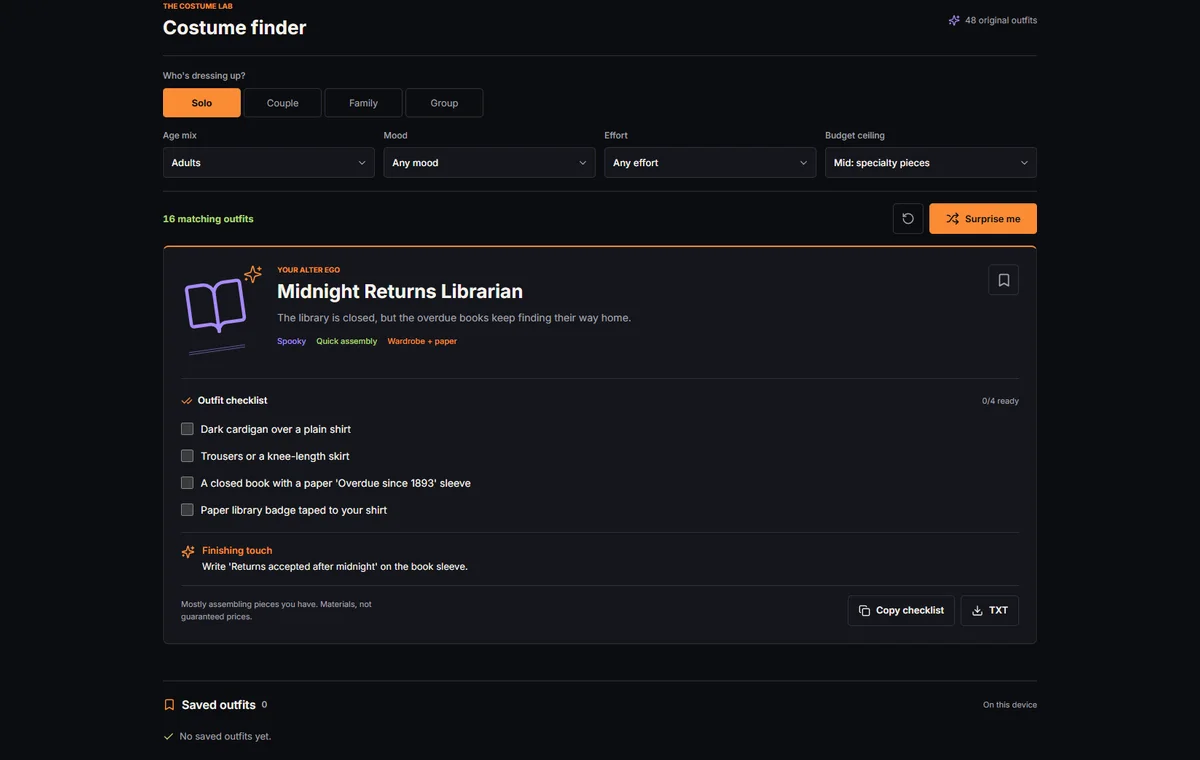
Choose Solo, Quick assembly and Wardrobe + paper. A dark cardigan, a book sleeve and a handwritten badge can turn the Midnight Returns Librarian into a clear idea without a shopping list full of specialty props.
A family with different comfort levels
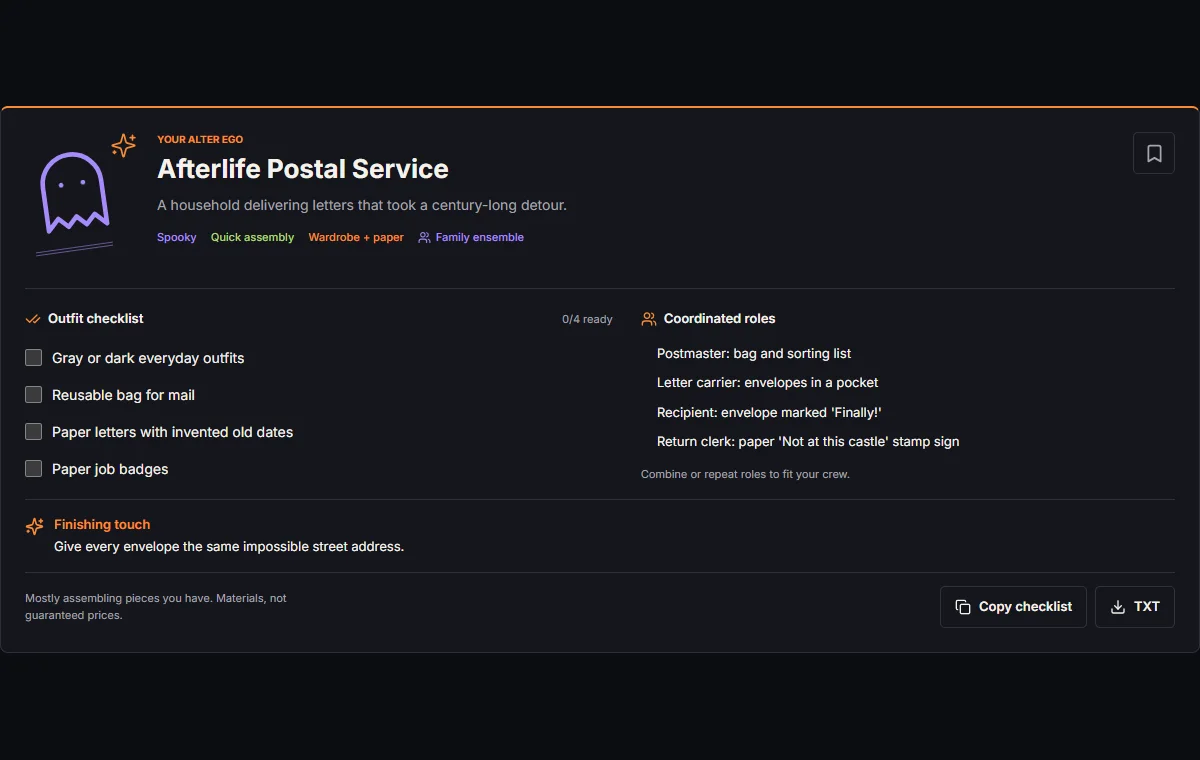
Choose Family and Mixed ages, then compare the coordinated roles. In the Afterlife Postal Service, one person can carry the mail while another wears only a recipient badge. The shared story does not require identical outfits.
A group making things together
Choose Group and DIY project, then set the material ceiling everyone accepts. Divide the roles and supplies before anyone starts crafting. Keep a TXT checklist for the shared session and leave time for a full try-on.
Turn a small story into a wearable outfit
Start with clothes and one clear detail
A useful costume idea needs more than a name. It needs an everyday base, a detail that explains the character and a practical way to carry or wear that detail. The finder supplies a short story, three to five material entries and a finishing touch. Treat these as a coherent starting plan rather than a requirement to buy a complete costume.
Work through the librarian outfit
For example, the Midnight Returns Librarian starts with a dark cardigan, a plain shirt and trousers or a knee-length skirt. Put a paper sleeve around a closed book and add the invented overdue date. A library badge supplies the role; the line about returns after midnight supplies the joke. Try the book in a comfortable bag if holding it for the whole evening would be tiring.
Gather, simplify and try on
Build the recognizable detail first, then decide whether anything else adds value. A legible badge and one well-chosen prop can tell the story more clearly than several unrelated accessories. Check the items as you gather them, but do not confuse a checked box with a fitting test. Walk, sit and use the outfit with the coat or bag you actually expect to take.
Understand exactly what a match means
Apply every filter
The collection contains 48 curated original concepts, not an unlimited stream of newly generated outfits. Party type and age mix must match the entry. A selected mood and a selected effort must match too; Any mood and Any effort remove only their own restriction. The budget control is a ceiling, so a plan requiring fewer materials can still appear under a higher tier.
Reroll within the matching pool
Changing a filter immediately updates the available pool and the displayed outfit. Surprise me chooses from that pool and avoids the current result when another match exists. It does not promise a never-repeating tour of the entire collection: an earlier outfit can return on a later click. If there is only one match, the button says Only match and is disabled.
Recover from no matches
An empty pool stays empty. For example, Family, Mixed ages, Low-key, DIY project and Wardrobe + paper currently has no match. Change the effort to Any effort to find the quick family options, or reset all filters. Solo with Mixed ages also has no match because a solo plan covers one wearer, not an ensemble. The tool never silently changes your restrictions to fill the result area.
Plan materials and effort without guessing a price
Read budgets as material tiers
The budget tiers describe the kinds of pieces in a plan, not a currency amount or a spending guarantee. A cardigan already in your wardrobe costs you nothing to reuse; the same cardigan bought specially changes your personal budget. Before choosing a tier, check clothes, paper, tape, reusable bags and craft supplies already available to the people taking part.
Allow time for making and fitting
Quick assembly usually means arranging familiar pieces and making a paper label or similar detail. DIY project means allowing time for cutting, attaching, fitting and possible rework. Neither label promises a number of minutes. A first-time paper collar, a drying adhesive or several people's badges can take longer than the name of the outfit suggests.
Reuse and count supplies
Reuse a sound base outfit and make the identifying detail removable where practical. Test an attachment on an inconspicuous part of the fabric before relying on it, and avoid cutting a valued garment just to follow a suggestion literally. Count supplies for the entire ensemble: four simple badges still need four usable attachments. Choose fewer, clearer details when time or materials are tight.
| Ceiling | Typical plan | What to check |
|---|---|---|
| Wardrobe + paper | Existing clothes, paper labels and household basics | Whether those basics are already available |
| Low: a few extras | Felt, ribbon, cardstock or fabric-safe attachments | The total quantities needed for every wearer |
| Mid: specialty pieces | Specific fabrics, display props or battery lanterns | Availability, fit and your own spending limit |
Coordinate people, not identical copies
Assign distinct parts
Solo concepts are for one wearer; couple entries provide two different roles. Family and group entries provide a shared setting with several roles to assign, combine or repeat. Their material list covers the ensemble, so agree who brings each prop rather than expecting every person to carry the entire list. The roles are prompts for coordination, not a fixed headcount calculator.
Adapt the postal-service example
The Afterlife Postal Service makes that distinction concrete. The postmaster handles the bag and sorting list, the carrier takes envelopes, the recipient receives a long-delayed letter and the return clerk carries a paper stamp sign. With three people, combine sorting and returns. With more people, add carriers or recipients with different invented addresses. A shared badge style connects the outfits without making everyone dress the same.
Plan for each wearer
Children, Adults and Mixed ages are planning filters, not garment sizes or a safety certification. Let each wearer choose the role, clothing shape and amount of decoration they find comfortable. Do not assign the delicate, scary or leadership role by gender or age. An adult can take the bulky prop; someone who wants less sensory fuss can use a plain base and a small badge. Adapt the plan to mobility needs and the venue rather than asking a wearer to adapt to a rigid costume.
Give the outfit a practical fitting test
Test everyday movements
Try the complete outfit in the setting it must work in: sitting at a table, using steps, carrying a bag or moving through a doorway. Remove a feature that obstructs a task instead of keeping it for the sake of the concept. Prefer lightweight carried props and keep ribbons or trailing pieces clear of feet. These are planning suggestions, not an assessment of any particular garment.
Check visibility, lighting and cosmetics
The CPSC costume guidance recommends good fit, visibility, ventilation, reflective tape and flashlights. For an outdoor dark outfit, plan a visible outer layer rather than assuming a small decorative accent will be enough. Washington State Patrol advises battery or LED lights instead of real candles; that also fits the lantern concepts here.
Makeup is optional; none of these concepts requires it. The FDA makeup guidance says to follow product directions and avoid products not intended for skin. Keep a paper symbol on the clothing if you prefer not to use cosmetics. A costume description cannot establish how a particular person will react to a material or product.
Recheck the complete outfit
Make one last check after adding a coat, shoes and any bag. Can the wearer see around the prop, remove it easily and manage an ordinary break? For children, arrange adult help for cutting and assembly. Replace a real flame with a suitable battery prop, and reconsider any detail that gets in the way of breathing, visibility or comfortable movement.
Read historical costumes as objects, not a single origin story
Interpret museum and photo records
Museum objects make costume history tangible. The Smithsonian Halloween collection includes fabric, paint, elastic and metal masks dated 1930–1950. That is a documented example of particular objects, not proof that every family, country or celebration dressed in the same way. Look at materials and construction before drawing a broad conclusion about a tradition.
The Library of Congress visual collections bring together photographs of Halloween costumes, decorations and customs. Compare an image's date, place and description with what is actually visible. A party photograph can suggest a silhouette or a way to display a prop, but it does not tell you that an old mask is suitable to wear today or establish one universal beginning for dressing up.
Borrow ideas without stereotyping
Use that distinction when borrowing inspiration. A paper label, an invented job or a shared color can give a modern outfit a story without copying an entire historical look. The concepts here are playful fictional roles, not reconstructions, sacred dress or representations of an ethnic group. Historical curiosity should add context, not turn a living identity into a costume.
Keep your shortlist and take a checklist with you
Keep favorites on this device
The bookmark saves an outfit in this browser on this device. Saved outfits appear below the primary tool, and opening one also sets the filters to match it. Removing a saved entry does not remove the concept from the collection. Only the stable outfit identifiers are stored; the displayed text follows the selected page language.
Recover when storage fails
Browser clearing, private browsing restrictions or denied storage can prevent favorites from lasting. If storage fails, the current tab still keeps its working shortlist and displays a warning. If an existing saved record cannot be read, it is left untouched. New session saves can replace that record only when you explicitly choose Replace stored list. Keep a TXT copy of an important plan before leaving the browser.
Carry an unmarked checklist
Copy checklist and TXT export include the concept, actual items, coordinated roles when present, finishing touch and material caveat, with ClockTools.app branding. The exported checklist is a fresh unmarked list; checkmarks in the tool are temporary gathering progress and reset when the result is revealed again. If copying or downloading is blocked, a selectable text area provides the same plan. A downloaded file can be shared separately, but favorites do not automatically sync with another browser or device.
How to read these suggestions
Method
The finder filters a fixed collection of 48 authored costume concepts by party, age mix, mood, effort and a material-based budget ceiling. A random choice uses only the matching pool and excludes the current outfit if alternatives exist. Every ensemble includes coordinated roles.
The labels describe a plan's materials and construction style, not quoted prices, measured preparation times or verified garment properties. The page's historical and practical guidance links to the primary museum and public-agency sources used for the narrow factual claims.
Limits
Not every filter combination has a result. These plans are adaptable ideas, not sizing instructions, product recommendations or a guarantee of suitability or safety. Check the actual materials, attachments, venue rules and each wearer's needs.
Favorites depend on this browser's local storage. Checklist progress is temporary, and exports are unmarked text lists. The tool does not reserve supplies, coordinate other people's browsers or ensure that a downloaded file has been kept.
Corrections and recovery
If the result area is empty, review the active filters or reset them; restrictions are never relaxed silently. If a saved record is unreadable, keep any session outfits you want before explicitly replacing the stored list. Copy or download the checklist before clearing browser data.
For a problematic outfit detail, remove or adapt the detail first. When reporting a content issue through the site's contact route, include the outfit name, page language and the specific wording or material that needs review. Do not include private browser data.
Costume planning questions
Does the generator invent a new costume on every click?
No. It chooses from 48 curated original concepts. Filters determine which entries are eligible, and Surprise me chooses another eligible entry when possible. There is no claim of an infinite collection.
Why can an inexpensive-looking outfit appear under the Mid ceiling?
The budget setting is a ceiling. Mid allows wardrobe, low and mid-material plans; Low allows wardrobe and low-material plans. The actual result label tells you which tier that outfit uses. None of the tiers represents a fixed amount of money.
Why are there no results for my filters?
The fixed collection may not contain your exact combination. Change one restriction deliberately or use Reset all filters. Solo with Mixed ages has no result because it describes one wearer rather than a mixed-age ensemble.
Can Surprise me show a costume I have already seen?
Yes. It avoids the current costume if another match exists, but it does not track a complete viewing history. A result from an earlier click can appear again. With one match, the reroll button is disabled.
How do we adapt a family result to three or six people?
Assign the distinct roles first, then combine tasks for fewer people or repeat roles with different names and labels for a larger crew. Agree who brings each shared prop. The tool offers coordination prompts, not a size-specific cast list.
Does Children mean the outfit has been safety-tested?
No. It means the concept can be planned for child wearers, not that any garment or prop has been tested. An adult still needs to assess fit, visibility, ventilation, movement, materials and the specific setting, and handle cutting where appropriate.
Will favorites follow me to another device?
Not automatically. They are saved in local browser storage, without a cross-device favorites account. Clearing browser data or storage restrictions can remove them. Keep a TXT checklist separately for a plan you need to retain.
What happens if copying, downloading or storage is blocked?
A blocked clipboard or download exposes selectable checklist text. Storage failures leave favorites usable in the current tab with a warning. An unreadable stored list is not overwritten until you explicitly choose to replace it.
Are the checklist ticks included in my TXT file?
No. The copy and TXT actions produce a fresh checklist with unmarked boxes, plus the roles and finishing touch. The ticks are temporary progress for the current view and reset when another result is revealed or the page is reloaded.