Take ten questions each. Keep the first set of answers a surprise until you have both finished.
A preference game, not a relationship assessment. There are no wrong answers.
Time together
Your first conversation, first date, or any day that matters to you.
Calendar days on this device, with the starting date counted as day zero.
A little room for the two of you
A little more behind the moment
Some tools answer a practical question. This one makes a little room for curiosity. Our love calculator starts with a playful score from two names, then offers something more personal: a chance to compare everyday choices and talk about the moments you share.
You can enjoy the name game on its own, pass the device for a two-person challenge, or count from a date that matters to you. These are three different activities. A name percentage is not evidence of affection; matching quiz answers is not a promise of a lasting relationship; a date counter measures calendar time, not the quality of that time.
01
A playful spark
Start with your names.
02
A date that matters
Count the days in your story.
03
A conversation for two
See where your choices meet.
No perfect script required.
How do you use our love calculator?
Start with a spark, linger over a memory, or make it a game for two. You choose how far the moment goes.
Step 1
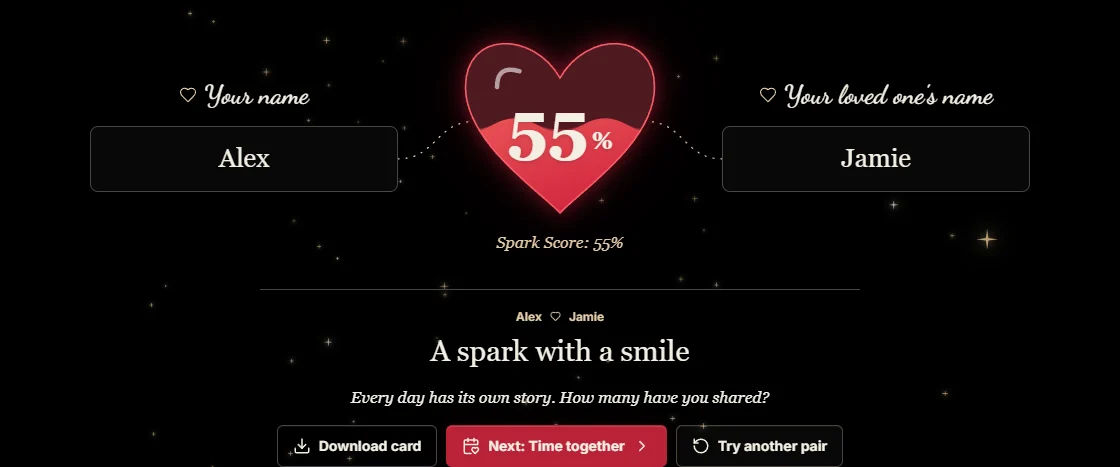
Start with two names
AlexJamie
55%Two names. One little spark.
Use first names, full names or nicknames, then choose Find our spark. Capitalization, spaces and punctuation do not change the letters we compare. A different spelling or nickname can produce another name-pattern result. Neither person's name has to go first.
Step 2
Remember a date
1 dayJanuary 1 January 2
Choose Time together and enter your first date, first conversation or another day worth remembering. See the total days, the calendar breakdown and your next anniversary. The starting date is day zero; the following date is day one.
Step 3
See where you meet
7 / 10Shared choices, room for discovery.
Choose Try together for ten questions each. The first answers leave the screen before the second person begins. Only after both turns do we reveal the shared choices, differences and a conversation starter connected to your answers.
Step 4
Keep a little moment
A little moment to keep.
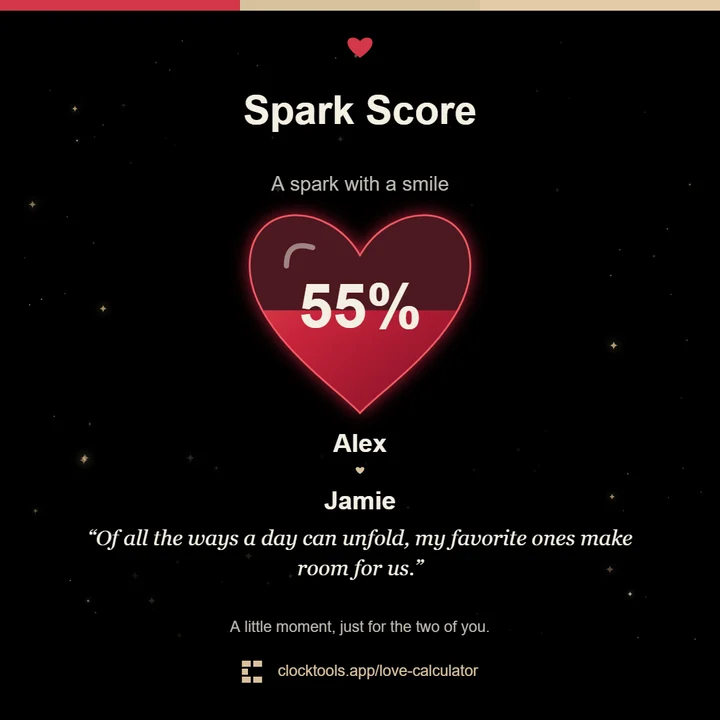
Download a square or portrait card with the heart, stars, your result and a love quote. Names are included initially; you can use initials or hide them before saving. Share deliberately, or keep it just for yourself. Nothing is posted automatically.
Not every moment needs an occasion
A few good reasons to make a little moment
A lighthearted first conversation
Try the name game with someone who wants to join in. Let the result be an opening for a chat, not a claim about what the other person feels. A lower score can be just as good a reason to laugh at the game and write your own story.
An ordinary evening together
Pass the device and answer before looking at each other's choices. A difference about quiet evenings or spontaneous plans can suggest your next shared activity. Give both preferences room, instead of deciding one of you has chosen the correct way to spend time.
An anniversary with a personal date
Use a first date, first conversation or another date you both enjoy remembering. Our counter separates total days from calendar years, months and days. The countdown opens a future anniversary as a setup you can review, not an alarm that starts without your permission.
A small card for someone you care about
Choose a format that fits your message, then decide whether names belong on the image. A card can be kept on your own device or deliberately shared. It includes ClockTools branding, but it never includes the two people's individual challenge answers.
A real card made with the fictional names Alex and Jamie.
For your camera roll, or someone special
Make the moment a keepsake.
A small shared joke, a name you love seeing beside yours, a date you like remembering. Our download turns that little moment into something you can keep, with the heart, stars, your result and a love quote all in one place.
Square or story-sized
Choose a 1080 × 1080 square or a 1080 × 1920 portrait PNG.
Your names, your choice
Names are included initially. Switch to initials or hide them before saving.
A fresh little line
A new card can bring a different quote. Changing the format keeps the same quote.
Some moments are worth a place in your favorites.
Thoughtful in the little things
Small details that make this feel better
Room for a little wonder
A ruby heart, a dark sky and a little champagne starlight make room for the moment. The heart fills before the result appears, with a fresh little heading for each new pair. The name score stays consistent, even when the words around it change. Reduced-motion preferences keep the experience quieter.
Names are treated as names
Accents, Cyrillic and other writing systems are welcome. We do not turn a non-Latin name into an empty string to make it fit an English alphabet. Equivalent Unicode spellings are normalized, while a genuinely different spelling remains a different entry in this word game.
A result you can interpret
The Spark Score is a repeatable name-game number. Shared choices count identical answers out of ten. Time together counts calendar days from your chosen date. We keep the labels distinct so a colorful presentation does not quietly turn a game into a claim of measured compatibility.
Personal entries are not a browsing history
Names, quiz answers and dates are held in this open page, not automatically saved as a personal history. Reloading or leaving clears them. A download or share action is your choice, and the ordinary tool link contains none of those entries. General site measurement is separate from the contents of your game.
Alex + Jamie, shown as an example. The name-pattern score stays the same when you reverse the names.
A little beyond the percentage
Every little spark has a backstory.
01
From folded paper to a number on a screen
Before the browser version, a love test could be a pencil, two names and a rule for counting letters. The amusement comes partly from seeing something ordinary become an unexpected result. A nickname changes the letters; changing the letters changes the game. That is a useful clue about what the number can and cannot tell you.
The LOVES playground game has even attracted mathematical study. That makes its number rules interesting, not its predictions reliable. Our version uses a bounded, repeatable name score instead of suggesting that a calculation has discovered somebody's feelings. You can enjoy the old spirit of the game without asking a percentage to make a real decision for you.
02
What do seven matching answers actually mean?
Imagine that both people choose the same option on seven questions and different options on three. Our challenge reports seven shared choices out of ten. It does not convert those answers into a probability of staying together, a measure of trust or an assessment of either person's character. There is no validated relationship scale hiding behind the result.
The differences can be the most useful part. One person might love a spontaneous Saturday while the other feels more relaxed with a plan. The next step is not to decide which answer wins. It is to ask what each person enjoys, what helps them feel comfortable, and whether an afternoon can include a little of both. Our prompts make room for that conversation; they cannot have it on your behalf.
03
Why do nicknames and spelling change the score?
A name calculator sees text, not a person. Alex, Alexander and a familiar nickname are different entries even if they refer to the same person. If a number changes between those versions, the relationship has not changed. The input to a word game has changed. Keeping that distinction in mind makes the result easier to enjoy without taking it too seriously.
There is also a less obvious kind of spelling difference: computers can represent some accented characters in more than one equivalent way. We normalize those equivalent forms so that an ordinary copy-and-paste difference does not invent a new name. We preserve writing systems and accents instead of pretending every name belongs to an unaccented English alphabet.
04
A year together is not always 365 days
Calendar time has its own small surprises. A leap year includes an extra day, months have different lengths, and daylight-saving changes mean a local day is not always exactly twenty-four elapsed hours. Our date counter compares calendar dates on this device. Your starting date is day zero; the following calendar date is day one. It is not an hour-by-hour record of the relationship.
Total days and a calendar breakdown answer different questions. Total days is useful for a milestone card; years, months and days give the date a familiar shape. For a February 29 start, choose whether a non-leap-year anniversary should use February 28 or March 1. We show the chosen future date so you can review it before opening a countdown. Your own convention matters more than pretending there is one universal celebration rule.
05
The best part can happen after the result
A percentage can catch your attention, but a small shared moment gives the visit a purpose. Choose a song that takes you back to a memory. Take turns planning an inexpensive evening. Ask about a detail from the other person's day that you usually miss. These ideas do not depend on a high score or a particular relationship label.
A useful ritual leaves room for both people to participate willingly. You can skip a question by leaving the challenge, stop at the name game, or keep a card without sharing it. There is no streak to protect and no score to improve by trying to answer correctly. The point is a little curiosity and enjoyment, not proving that your connection meets a numerical target.
Three activities. Three different answers.
How are the three results worked out?
The name spark
The name game compares shared letters, their order, name lengths and repetition patterns. Equivalent Unicode spellings are normalized; capitalization, spaces, punctuation and numbers do not add points. A fixed game rule produces an integer from 1 to 100, and reversing the names does not change it. Accents and writing systems stay intact. This is a comparison of text, not a reading of personality, birthdays, astrology, messages or behavior. The same letter patterns give the same result under this rule, regardless of interface language.
Your days together
Time together uses calendar-date arithmetic from the chosen starting date to today's date on the device. It rejects invalid or future starting dates and offers an explicit rule for February 29 anniversaries. Our checks cover repeatability, swapped names, international text, incomplete challenges, leap dates, long labels and export failures. These are checks on the tool's behavior, not evidence that a game can predict love.
Your shared choices
The two-person challenge compares ten completed answers directly. Each identical option adds one shared choice, with two questions in each of five everyday categories. There are no hidden weights for a supposedly better personality. All twenty responses must be present before a comparison is shown. A difference creates an invitation to talk, not a penalty or a warning about the relationship.
A Spark Score is not the percentage of love between two people. A matching-answer count is not a psychological assessment. Neither can tell you whether someone likes you, whether a relationship is healthy, or whether you should begin or end one. Even a result of 100 is still a game result.
A shared device is still shared
The challenge includes ordinary preferences, not a complete account of either person's values, boundaries, circumstances or behavior. Answer only if you want to. A shared device does not provide secure separation from someone who controls that device, and hiding a name on a card is not anonymous storage of the original page.
Dates, downloads and your device
Results disappear when this page reloads or closes. Offline reopening is not guaranteed, even though the already-loaded game needs no remote calculation. Calendar results depend on the device date. Native image sharing depends on browser support; downloading the PNG is the alternative. Clearing an entry is not secure erasure from a device's memory, clipboard or downloaded files.
Made with care. Open to getting better.
Help us make the little details right
If a result behaves unexpectedly, tell us the browser, selected activity and what you expected to happen. Use made-up names and sample dates instead of private relationship details. For a date issue, include the displayed device date and selected February 29 rule; for an export issue, include the chosen card size and whether names were hidden.
We check confirmed problems against repeatable examples, update the affected behavior and review the matching explanation and translations. A changed name score alone is not proof of a compatibility problem; first check whether the letters, spelling or name itself changed. You can report a wording issue just as readily as a calculation or layout issue.
It is a real, working game, not a scientific test of love. The Spark Score comes from names. The two-person challenge counts matching choices, and the date counter measures calendar time. None of them measures affection or predicts whether a relationship will succeed.
Why do I get the same love percentage again?
The name-pattern rule is fixed and repeatable. Reversing the names, changing capitalization or choosing another interface language does not change the result. Spaces, punctuation and numbers do not contribute to the letter comparison. A different spelling or nickname may give another percentage, although different pairs can also share a score.
Should I use a first name, full name or nickname?
Use whichever names make the moment feel right to you. Full names do not make this game scientifically more accurate. Different text can change the score, so use the same spelling if you want to reproduce an earlier result. Names can contain up to 60 Unicode characters each.
Do accents and non-English names work?
Yes. We preserve accents and writing systems, including Cyrillic, and normalize equivalent Unicode spellings. Capitalization and extra whitespace do not create a new pair. We reject entries made only of symbols and unsafe hidden direction-changing characters instead of displaying a misleading result.
What if we answer every challenge question differently?
The result is zero shared choices out of ten, not zero love. It means you selected different options in this particular game. Review the answers only when you both want to, and use a prompt as a conversation starter rather than treating the result as a verdict.
Can the second person see the first answers?
The first answers leave the displayed question flow before the handover. Both sets become available after both turns are complete. This is a game on one shared device, not a secure survey system; someone who controls the device may still be able to inspect its contents.
Do you save our names, answers or date?
This tool does not automatically save those entries in a history or send them for a remote calculation. They stay in the open page. A PNG can contain names only when you choose to include them, and the ordinary tool link contains no personal entries. Closing or reloading the page clears the active game.
Can I share a card without our names?
Yes. Names are included initially, but you can switch to initials or hide them before downloading or sharing. The image never includes individual quiz answers. Square and vertical story formats both include a small ClockTools credit and website address.
How do you count days and leap-day anniversaries?
The starting date is day zero and the following calendar date is day one. We compare dates rather than dividing elapsed milliseconds by twenty-four hours. For February 29 in a non-leap year, you can choose February 28 or March 1. Review the displayed anniversary date before creating a countdown.
Does the love calculator work offline?
The already-loaded name game, challenge and date calculations do not need a remote calculation service. However, closing the page and reopening it offline is not guaranteed to work. Installing a website shortcut is not a promise of full offline availability.