- Why does the converter reject IIII?
- Four is IV in the converter's selected grammar. A clock showing IIII is using another notation convention, not necessarily displaying a wrong number. For a new canonical heading use IV; for a transcription keep the observed IIII and add an explanatory value if needed. The tool does not infer values from additive source notation or automatically rewrite it.
- Which subtractive pairs are allowed?
- Only IV, IX, XL, XC, CD and CM, within their own place groups. To write 99, use XCIX, not IC; to write 49, use XLIX, not IL. The tempting shorter strings skip a place and fail the declared grammar. A syntax warning gives no guessed total, so return to the intended integer or original source before correcting the string.
- Does the breakdown add individual letters or subtractive pairs?
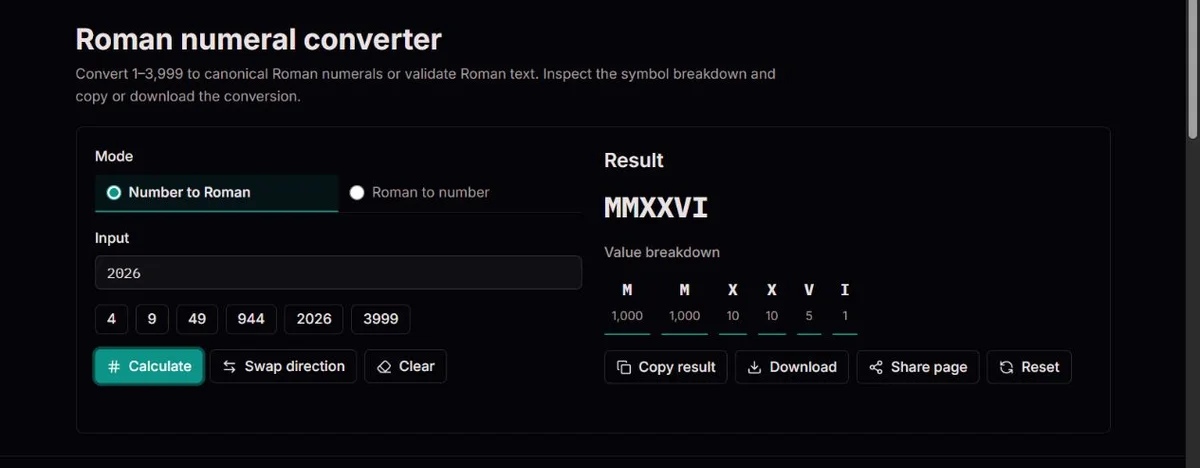
- It adds validated tokens. For CMXLIV the tokens are CM = 900, XL = 40 and IV = 4, not six unrelated letter values. An ordinary repetition such as MM appears as two M tokens, each worth 1000. Read the approved pairs as units before summing; otherwise adding every visible letter would give the wrong total.
- Can I paste Unicode Roman numerals such as ⅩⅣ?
- Yes, those compatibility forms become XIV and can validate. That normalization is narrowly limited to U+2160 through U+217F. It does not translate all numeric symbols or turn a Cyrillic Х into Latin X. If a visually identical paste fails, retype the intended Latin letters and compare the result with the source. For interchange, ordinary letters usually avoid dependence on special numeral glyphs.
- Why are zero and 4,000 unsupported?
- This ordinary-letter grammar covers 1 through 3999 and has no zero token. The limit is a converter boundary, not a claim that historical notation could not express larger numbers. For a value needing an overline or another extension, first establish the intended convention and use a tool that supports it explicitly. Removing the mark to make a paste validate can change its intended value.
- Should I correct a historical source that fails validation?
- Not automatically. Transcription records what is visible; conversion chooses a reading rule. Keep the observed letters, marks and styling, check the photograph or original for OCR errors, and put any normalized value in a separate note. A rejected clock form, official title or inscription is not evidence that you should rewrite the artifact or rename the work.
- Why is 1,000 rejected while 1000 works?
- Number mode requires digits without grouping punctuation. Enter 1000, regardless of whether your locale normally writes 1,000, 1.000 or 1 000. Leading zeros such as 0049 are accepted and do not change the integer, but a plus sign, decimal fraction or exponent expression is not accepted. The resulting Roman value is based on the integer, not its original display width.
- Can I convert a whole date or several numerals at once?
- No. The field handles one integer or one Roman numeral. Convert a date's day, month and year separately if that is the format you need, then add separators yourself. Pasting a sentence, a list or internal spaces produces a character or digit warning rather than separate results. A year like MMXXVI does not by itself encode which date format or calendar you intended.
- What does Swap direction check, and what does Copy contain?
- Swap is enabled for a valid result and moves that exact value into the opposite input mode, which is useful for catching an unintended numeral before reuse. It does not repair a rejected string. Copy and Download include the decimal value, Roman form and token breakdown together. Share sends the tool link only, not a conversion history or the current input.