Step 1
Set a match target
+1 -1 0
Quick ends at one point, Best of 3 at two points and Best of 5 at three. Draws award no points.
The computer uses a fresh random choice for every round. Repeats are allowed, including two draws in a row.
The computer uses a fresh random choice for every round. Repeats are allowed, including two draws in a row.
+1 -1 0
Quick ends at one point, Best of 3 at two points and Best of 5 at three. Draws award no points.
3 2 1
Use the three move buttons or R, P and S outside editable controls. Both choices stay concealed during the countdown.
1 : 1
0
Equal moves are a draw. Continue the match, or start again after the target is reached. Export recent rounds for comparison.
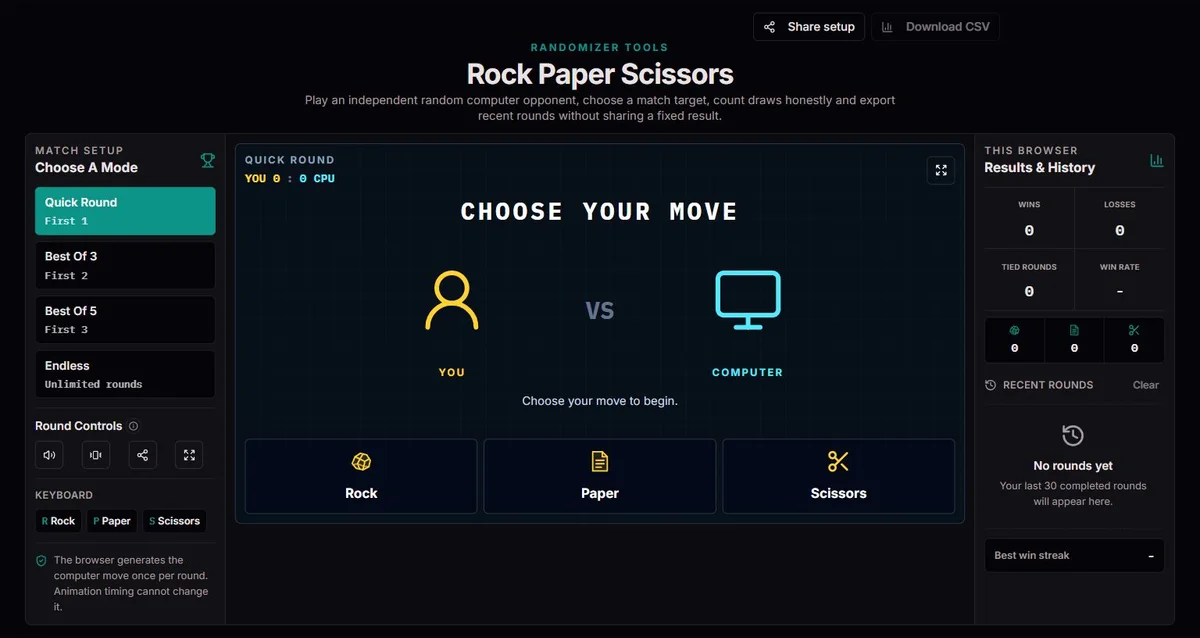
Choose Quick for the first decisive round, keeping draws as valid zero-point rounds. Use sound off in a shared room if needed. A repeated face-off is allowed; do not mistake a lucky streak for a skill rating. This is a local game against a random computer, not a remote multiplayer invitation.
In Endless, play a fixed move for a short recorded sample, then compare a changing sequence. Each move has one winning and one losing counter, so none dominates. The history move counts describe your choices, not the computer’s. Human response habits in the cited study do not establish that this opponent predicts you.
For first to two or three points, write the target before starting and export rounds afterward. A sequence draw, player win, computer win, player win ends first-to-two at 2:1 after four rounds. Check scores against decisive outcomes, not the number of CSV rows. Keep records before clearing the 30-round window.
| Rock | Paper | Scissors | |
|---|---|---|---|
| Rock | 0 | -1 | +1 |
| Paper | +1 | 0 | -1 |
| Scissors | -1 | +1 | 0 |
Rock defeats scissors, scissors defeat paper, and paper defeats rock. This cycle has no strongest move. A strategy that always chooses one move can be countered by a human who recognizes it.
The researchers examine repeated human play and conditional responses in their study of social cycling and conditional responses. This provides useful context for human habits, but it should not be confused with the behavior of this independently random computer.
Against a uniform opponent, any fixed player move has a one-third win, one-third loss and one-third draw probability per round. Predicting a counter after three repeated rocks does not help here: the computer does not use your previous moves to choose its next one.
The Web Cryptography specification defines the browser random source. Rejection sampling accepts a range divisible by three before mapping a value to rock, paper or scissors, avoiding a small modulo imbalance.
There is no anti-repeat smoothing. Preventing the computer from repeating its last move would change the next round’s probabilities and could make some outcomes impossible after a repeated player choice. Two identical rounds are allowed.
The computer move is fixed at the start of the countdown; animation only reveals it. A draw records the round but does not change either score. A first-to-three match may need more than five total rounds because draws do not advance the target.
Quick targets one point, Best of 3 two and Best of 5 three; Endless has no target. Draws record rounds but award no points, so a match can exceed the label’s nominal round count. Choose a move using the buttons or R/P/S outside editable controls. Once countdown starts, both moves are fixed; further clicks do not replace your choice or queue another round.
Play Next Round returns to move selection while keeping the current match scores. Reset Match starts a new score, while completed history remains. During the countdown, the separate Cancel button stops the unfinished round and starts a new match; it does not add a completed history record. Changing mode also starts a new match. Clear removes the retained history and its statistics, not the current opponent’s probabilities. Share setup preserves the selected mode for a fresh local game, not current moves, points or an online opponent.
Rock beats scissors, scissors beat paper, and paper beats rock. In an illustrative first-to-two sequence draw, win, loss, win, the score ends 2:1 after four recorded rounds. The match score covers the current match, while statistics cover the retained history across matches. If history was cleared midway, its rows need not explain every point still on the match scoreboard.
Win rate divides player wins by all retained rounds, including draws. Two wins, one loss and one draw therefore give 50%, not two-thirds. A draw or loss breaks the player’s consecutive win streak. Move counts are the player’s selections. Up to 30 rounds are stored, so older outcomes dropping out can change percentages and longest streak. This is a sample description, not a lifetime rating.
| Measurement | Value | Reason |
|---|---|---|
| Match score | 2:1 | Only win/loss rounds award points. |
| Recorded rounds | 4 | The draw remains in history. |
| Win rate | 50% | 2 player wins / 4 total rounds. |
| Consecutive player wins | At most 1 in this sequence | The intervening loss breaks the run. |
Against a uniform independent computer, choosing rock every time still gives one-third chance each of win, loss and draw per round. Switching after a loss does not force a win. Humans may respond to patterns, but the computer here does not learn, bluff or counter your history. A short run of repeated rocks is possible; forcing alternation would change the experiment rather than repair it.
If a key seems inactive, check whether focus is inside a control, a countdown is pending or the match has ended. Choose Play Next Round or Start New Match as appropriate. Audio, vibration and fullscreen are optional and can fail without changing the written outcome. A randomness error does not supply a valid move. For a rule mismatch, record both moves, outcome, mode and score rather than reporting only a surprising streak.
rock / rock → 0 : 0Neither player earns a point. A second rock/rock draw remains possible.
paper / rock → +1Paper covers rock. Only the player score increases.
Best of 5 → first to 3The target counts won rounds, not a maximum of five rounds including draws.
The computer chooses one of three moves with rejection sampling and no history-dependent reroll. Matching moves are draws. Quick, Best of 3 and Best of 5 mean first to one, two and three points respectively; Endless has no target.
The last 30 rounds are stored locally when possible, so statistics are not a lifetime rating. The opponent is not AI that learns or a remote player. Sound, vibration and fullscreen depend on browser support. Do not treat this game as certified contest or gambling equipment.
Report the player move, computer move, displayed outcome, mode and score if a round appears inconsistent. Export recent rounds for a minimal example. Reset Match starts a new match; during the countdown, Cancel stops the unfinished round. Clear removes completed history separately.
Yes. Every computer choice is independent. Removing repeats would alter the advertised probabilities.
No. Quick ends at the first point, so drawn rounds can be followed by another choice.
No. It does not adapt to your moves or use previous rounds to pick a counter.
The displayed rate includes drawn rounds in the denominator. Two wins, one loss and one draw give 2/4 = 50%. A decisive-round rate would answer a different question and is not the displayed statistic. Check the retained history scope too.
No. Reset Match starts a fresh match score but leaves completed history. During a countdown, use the separate Cancel control to stop the unfinished round and start again. History is cleared separately, so its statistics can span several matches and differ from the current score. Export before clearing records if you need a comparison.
R, P and S do not select a move while focus is in an editable field or another interactive control. A pending countdown and a completed match also block a new round. Choose Play Next Round or Start New Match as appropriate, then use the move buttons if necessary. Use Cancel if you want to stop an unfinished countdown. These controls prevent overlapping or accidental choices.
No. It shares the match mode, not a multiplayer room, live scoreboard or fixed round. The recipient plays a fresh local computer opponent. Use a separate agreed process if two people need to reveal simultaneous human choices.
No finite sequence is guaranteed. Against this uniform independent model each round permits all three outcomes. No fixed move is universally strongest, but repetitions and streaks can still occur. The probability model describes opportunities, not a promised pattern of results.