Step 1
Choose temperature
25°C
Enter −40 to 60°C or the equivalent in °F.
Use a paired air-temperature and relative-humidity reading, not values from different rooms or hours.
Use a paired air-temperature and relative-humidity reading, not values from different rooms or hours.
25°C
Enter −40 to 60°C or the equivalent in °F.
55%
Enter a percentage above zero and up to 100%. At saturation, dew point equals air temperature.
15.3°C
Compare the estimate with the actual surface temperature. A small gap alone does not guarantee fog or condensation.
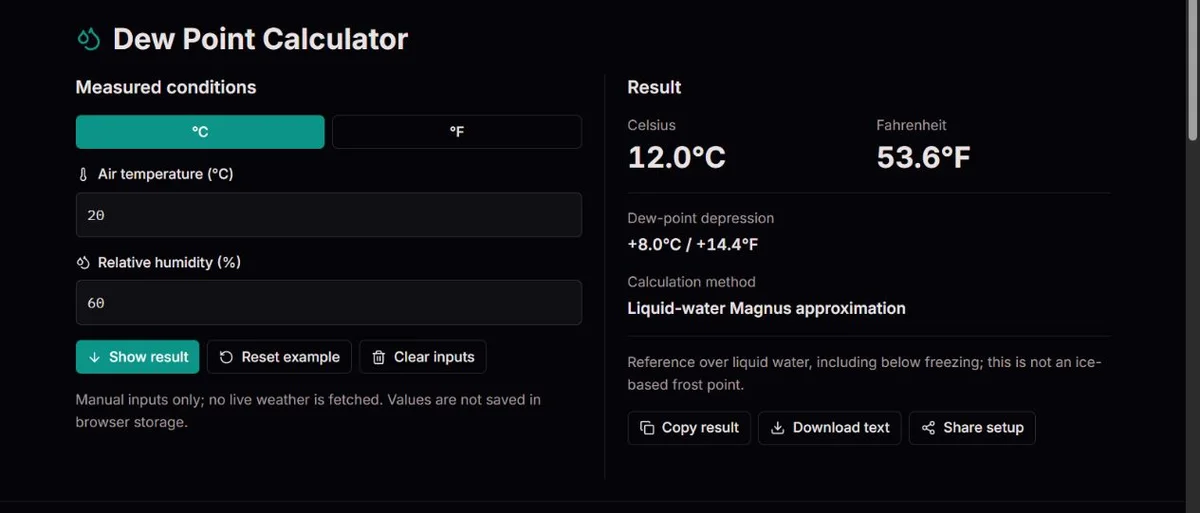
For window condensation, take the room temperature and humidity near the area of concern, then separately measure the inner pane. At 20°C and 60%, dew point is about 12.0°C. A pane at 10°C is below that threshold; one at 15°C is above it under the same surrounding-air conditions.
This comparison helps explain why one window wets while another stays dry. The calculator does not measure the glass, diagnose a leak or model the cold air beside it. Repeat the readings when cooking, showering or ventilation changes the room conditions.
For a camera taken from an air-conditioned room into warm humid air, use the outdoor reading, not the room's humidity. At 30°C and 70%, the estimate is about 23.9°C. Equipment still at 18°C is below that threshold, so the surrounding outdoor air can condense on it as it warms.
The practical comparison is equipment surface temperature versus local dew point. The page cannot calculate a waiting time: mass, materials, airflow and the temperature inside the equipment are not inputs. Follow the equipment maker's handling advice rather than treating the estimate as clearance to use it.
For ventilation, compare separate indoor and outdoor pairs. Indoors at 20°C/60% gives about 12.0°C; outdoors at 10°C/80% gives about 6.7°C. Despite the higher outdoor relative humidity, that air has a lower dew point and can provide drying potential when warmed indoors.
This is a direction of moisture comparison, not a drying-rate prediction. If outside dew point is higher, bringing that air in may increase the moisture load. Mixing, ongoing moisture sources, rain and airflow determine what actually happens.
Relative humidity is the ratio of actual water-vapor pressure to saturation vapor pressure at the current temperature. Dew point expresses that vapor pressure as a saturation temperature. Saying warm air can hold more water is common shorthand, but the calculation is a relationship between vapor pressures, not a container filling with water.
Enter the temperature and humidity measured together. A thermometer in direct sun and a hygrometer inside the house do not describe one air sample. After moving a sensor, wait for its reading to stabilize according to its instructions. A wall, air-conditioning outlet or open window can make a local reading different from the middle of a room.
Enter 55 for 55%, not 0.55. A value of 0.55 is accepted as 0.55%, a much drier mathematical input. The calculator cannot tell that the wrong convention was intended. Temperature selectors convert the current value, and fractional percentages are allowed; neither feature compensates for a poorly placed or uncalibrated sensor. NWS vapor-pressure relationship used to calculate dew point.
Relative humidity is a ratio to saturation at the current temperature. Cooling air can raise that percentage without adding water vapor. Dew point instead asks how far the air must cool, at essentially constant pressure and moisture content, to reach saturation.
Two places with the same percentage can therefore contain very different amounts of water vapor. A cool morning with high relative humidity need not be muggier than a warmer afternoon with a lower percentage. Dew point makes that comparison more meaningful, although comfort still depends on other conditions. NWS explanation of dew point versus relative humidity.
At 25°C and 55% relative humidity, this liquid-water approximation gives about 15.3°C, a temperature gap of about 9.7°C. A pane near 14°C may collect condensation while a wall at 20°C does not. Those are fixed illustrative temperatures, not measurements of your room.
At 100% humidity, the calculated dew point is exactly the air temperature. At 0%, the logarithm needed by this formula has no finite dew-point solution, so the tool asks for a positive reading. Below freezing, this is still a liquid-water reference; an ice-based frost point requires a different saturation relation. NWS reference calculation from temperature and humidity.
Dew-point depression is air temperature minus dew point. Unlike the signed differences on the other weather calculators, it is a nonnegative gap for the accepted inputs. At 25°C/55%, the 15.3°C dew point gives a gap of about 9.7°C, or 17.4°F. It is not a prediction that the air will cool by that amount.
Holding temperature at 25°C while increasing humidity raises dew point, as the examples show. A surface at 14°C is above the 40% example's threshold but below the 55% and 70% thresholds. That changes the condensation comparison even though the room thermometer has not moved. Surface temperature is an independent measurement that this page does not supply.
A small air-temperature gap can be useful when discussing saturation, but it does not specify cloud formation, rain or visibility. Air near a cold pane can differ from the room sample, and moisture can be added or removed before air reaches saturation. Use the result to ask which surface or air layer will cool, not to announce that fog is inevitable.
| Relative humidity | Dew point | Air minus dew point |
|---|---|---|
| 40% | 10.5°C | 14.5°C |
| 55% | 15.3°C | 9.7°C |
| 70% | 19.1°C | 5.9°C |
| 100% | 25.0°C | 0.0°C |
Liquid-water engine examples rounded for display. These are not surface measurements.
If air is warmed without adding or removing vapor, at roughly constant pressure, relative humidity falls while dew point stays roughly unchanged. Heating therefore can lower the percentage without removing water. Cooling reverses that trend until saturation is reached; after condensation begins, the unchanged-moisture assumption no longer describes the same air sample.
This distinction matters in drying and indoor-air conversations. Lowering dew point requires reducing vapor pressure, for example through moisture removal or replacement with drier air. Simply selecting a higher temperature in the calculator while leaving humidity fixed describes a different moisture content; it is not a simulation of heating the original air.
To compare outdoor comfort across hours, use the calculated dew points as moisture context, not universal comfort categories. A higher dew point indicates greater vapor pressure and often a muggier setting, but air temperature, wind, sun and activity still affect the experience. For heat exposure, use the relevant heat measure rather than treating dew point as a heat index. NWS explanation of temperature, relative humidity and dew point.
At very low humidity, a small absolute change can be large in relative terms. At 25°C, 1% gives about −34.7°C and 2% about −27.5°C. That seven-degree change is a warning against trusting a dry-end sensor reading to excessive decimal precision. Zero is rejected because the logarithmic approximation has no finite solution there, not because the page forgot a dry-air category.
Below freezing, check whether a reference uses saturation over liquid water or ice. This page continues to use liquid water. A frost point, a measured dew point from an instrument and a value from another Magnus coefficient set need not agree digit for digit. The supported −40 to 60°C air-temperature input range is not an error bound for all moisture conditions.
For a mismatch, save both inputs, units, sensor context and the reference's saturation convention. Copy result or Download text records the estimate and method; Share setup records the fields in a link. Clear inputs empties the form, Reset example restores the demonstration, and Show result moves to the already updated result. No weather is fetched and no input history is stored locally.
The Magnus/Tetens liquid-water approximation uses Celsius internally, with a = 7.5 ln(10) and b = 237.3°C, consistent with the linked NWS calculation. Supported air temperatures are −40 to 60°C and humidity must be above zero and no more than 100%. Dew-point depression is air temperature minus dew point.
γ = ln(RH/100) + aT/(b + T); Td = bγ/(a − γ); a = 7.5 ln(10), b = 237.3°C
This is an approximation from manual inputs, not a measured dew point, wet-bulb temperature or frost point. Sensor calibration, saturation conventions and conditions at the surface affect comparisons. Very small humidity readings magnify uncertainty; the supported input range is not a precision guarantee.
Testing methodologyInclude temperature, unit, humidity, sensor context and the reference formula when reporting a mismatch. Check whether your source uses saturation over water or ice. Rounded humidity, especially near zero, can noticeably change the estimate.
Corrections policyFor the accepted 0 < RH ≤ 100% inputs, this formula never returns a higher dew point. At 100%, the two temperatures are equal. Inconsistent observations or supersaturation need separate treatment.
No. Cooling, moisture supply, mixing and local surfaces matter. This calculator estimates a saturation threshold; it does not forecast visibility or rain.
Heating alone can lower relative humidity without lowering dew point, if vapor content and pressure stay roughly unchanged. To represent that process, humidity would have to change as temperature changes. Keeping 60% fixed while raising temperature in the form describes adding moisture, not merely heating the original air.
Yes, if its dew point is lower than the indoor dew point. The fixed 10°C/80% outdoor example gives about 6.7°C, below 20°C/60% indoors at about 12.0°C. Compare paired readings, not percentages alone. That comparison does not tell you the ventilation rate or how quickly a surface will dry.
The field expects percent, so 0.55 means 0.55%, not 55%. Both are positive inputs and can be calculated, but they represent very different air. Enter 55 when the sensor reads 55%, and keep any reported uncertainty in mind before relying on the last decimal.
No. Dew point is a saturation temperature related to vapor pressure; wet-bulb temperature involves evaporative cooling. This calculator has no wet-bulb output. A wet-bulb globe temperature assessment is another distinct measure and cannot be reconstructed simply by relabelling the dew-point result.
No. The output is referenced to liquid water even below freezing. Frost depends on the surface, the ice saturation relation and surrounding conditions. A negative value describes a moisture threshold, not a forecast that a particular window, road or plant will frost.
No. It can help compare local dew point with a measured surface temperature, but it has no moisture-source, material or time-history inputs. Persistent damp can have several causes. Use the saved readings as context for an investigation, not as a diagnosis or a guarantee that a room is healthy.