Morse Code Tools
What Does Morse Code Sound Like?
Morse code is a timed rhythm of short tones, long tones, and meaningful silence.
By Vigneshwaran Vijayakumar, Developer and Publisher | | Reviewed under the ClockTools editorial policy
Table of contents
Morse code sounds like groups of short and long tones separated by deliberate silences. A dot is one timing unit, a dash is three units, the gap inside a character is one unit, the gap between characters is three units, and the gap between words is seven units. The pitch can change; the timing relationships carry the message.
Open the ClockTools Morse Audio Translator, enter a short word such as TIME, and listen once before looking at the dots and dashes. That small experiment makes Morse code feel like rhythm rather than punctuation.
A listening lab: dot, dash, letter, word
Begin with two one-character messages. E is a single dot, so it produces one short tone. T is a single dash, so it produces one tone held three times as long. Nothing about the frequency has to change between them.
Now try A, written .-. You hear a short tone, a one-unit silence, and a long tone. Try N, written -., and the durations reverse. At this scale, the ear can identify the whole character as a compact shape: dit-dah for A and dah-dit for N.
Move to TIME:
| Character | Written Morse | Audible shape |
|---|---|---|
| T | - | dah |
| I | .. | dit-dit |
| M | -- | dah-dah |
| E | . | dit |
The three-unit gaps between characters are as important as the signals. Remove them and the same dots and dashes can group into different characters. Written spaces are therefore instructions for silence, not empty decoration.
The 1-3-7 timing frame
The ITU International Morse recommendation defines the signal repertoire and timing relationships used for International Morse code. You can picture the pattern on a unit grid.
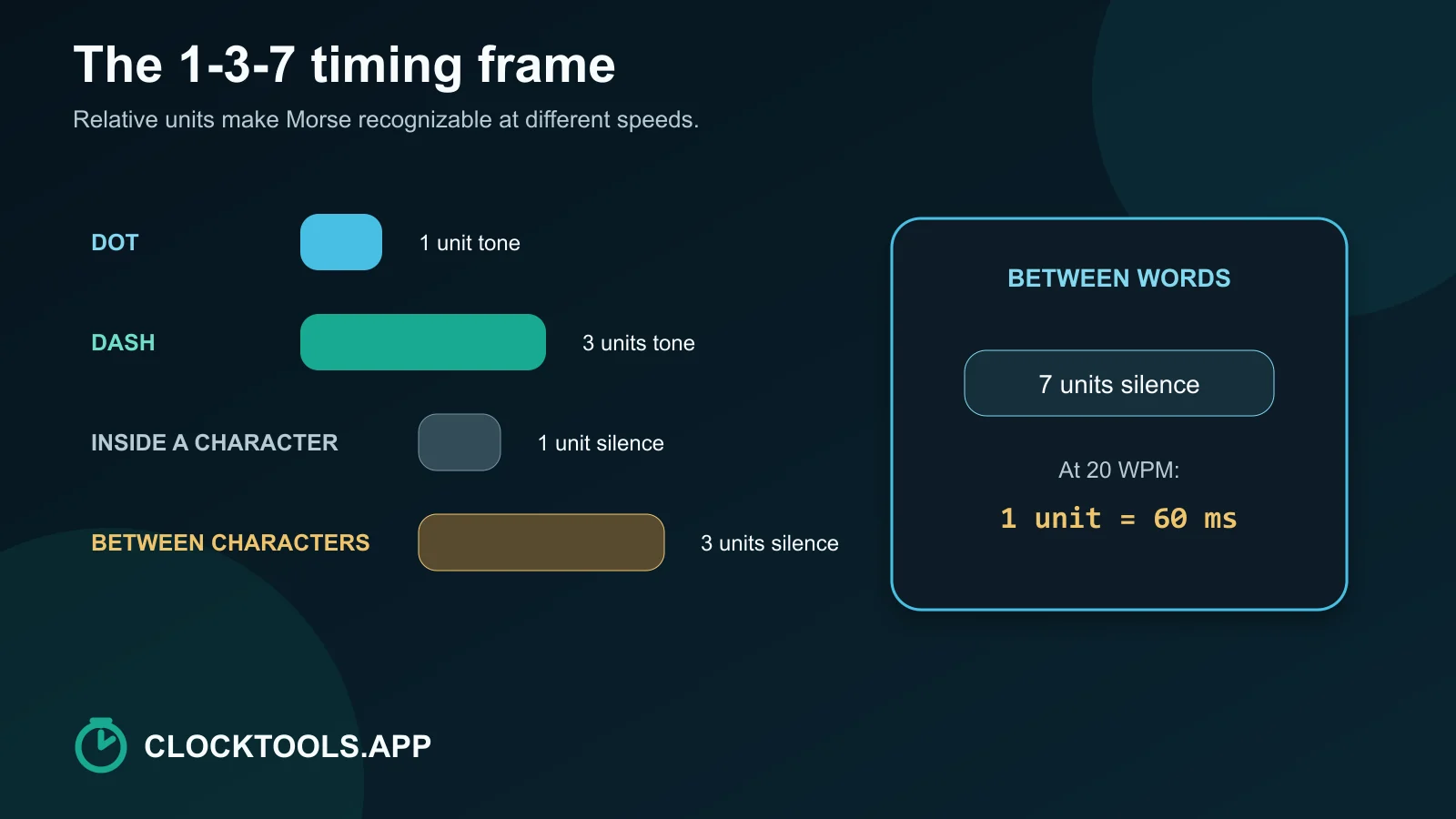
| Element | Duration in base units | What you hear |
|---|---|---|
| Dot | 1 | short tone |
| Dash | 3 | long tone |
| Gap inside one character | 1 | brief separation |
| Gap between characters | 3 | character boundary |
| Gap between words | 7 | word boundary |
At 20 words per minute under the common PARIS timing convention, one base unit is 60 milliseconds. The ratio matters more than memorizing that particular duration. At 10 WPM, the unit doubles; the dot, dash, and gaps expand together.
ClockTools uses 1.2 / WPM seconds for the base unit in its audio and WAV paths. In the live source check, the default speed was 18 WPM, the speed slider covered 5 through 40 WPM, and the exported WAV used the same unit calculation as playback.
Why does pitch not change the message?
Pitch controls how high or low the tone sounds. Volume controls amplitude. Neither replaces timing. A 500 Hz dot and a 900 Hz dot can represent the same signal if their durations and surrounding gaps are equivalent.
Choose a pitch that remains clear on your speaker or headphones without becoming harsh. The ClockTools pitch and volume controls exist for listening comfort and device differences. They are not extra Morse symbols.
This distinction is useful when comparing sound, light, and vibration. A lamp has no audible pitch, yet it can carry International Morse timing through short and long flashes. A vibration pattern can do the same where the device and browser support it. The medium changes; the active and silent intervals preserve the code.
The Morse Code Chart helps when a sound is clear but unfamiliar. Select a character, inspect its written pattern, and replay it. For a complete unknown written message, use the Morse decoder after you have identified the groups.
Hearing SOS without misreading spacing
SOS is familiar because its shape is strongly balanced: three short signals, three long signals, then three short signals. The distress signal is sent as one continuous procedural pattern, ...---..., rather than as an ordinary word with full character gaps between S, O, and S.
That means two displays can look similar while sounding different:
...---...uses one-unit internal gaps throughout the continuous signal.... --- ...inserts three-unit character gaps around the O.
Both arrangements help a learner see S-O-S, but only the continuous prosign preserves the compact distress rhythm. Treat this as an educational listening example. It is not a replacement for contacting local emergency services through the appropriate channel.
Count the active units in the continuous signal: three one-unit dots, three three-unit dashes, and three one-unit dots produce 15 units of tone. Eight internal one-unit gaps bring the complete signal to 23 units. At 20 WPM, 23 × 60 ms equals 1.38 seconds. That calculation is an original checkable artifact, not a measured emergency transmission.
Configure ClockTools for a clean first listen
The live audio page exposed WPM, Farnsworth speed, pitch, volume, repeat, light, vibration, WAV download, and image export. A reproducible first-listen setup is simpler than using every control at once.
- Enter
TIMEas text and confirm the generated groups are- .. -- .. - Set speed to 18 WPM and keep repeat off.
- Leave Farnsworth at or below the character speed if you want extra recognition time between characters.
- Choose a comfortable pitch and moderate volume.
- Press Play once, then compare the sound with the visible character table above.
- Turn on repeat only after you can identify the word boundary.
Farnsworth timing keeps the characters comparatively crisp while lengthening the spaces that separate them. This can make individual characters sound more natural than slowing every dot and dash to a crawl. The ARRL learning resource also emphasizes learning Morse as sound rather than building a visual lookup habit.
Two source-and-tool observations passed reproduction. Changing pitch altered the oscillator frequency without changing the generated dot-dash sequence. Lowering Farnsworth speed increased gap timing while leaving the WPM-based signal unit unchanged.
From written code to character sound
Reading .- as “dot dash” is accurate but slow. Listening practice aims to recognize A as one sound shape. Use short contrasts instead of an entire alphabet wall.
Try these pairs:
- A
.-and N-.reverse the same two elements. - U
..-and D-..move the dash from the end to the beginning. - S
...and O---keep the count but change every duration. - R
.-.and K-.-alternate from different starting elements.
Play one pair, hide the visual answer, and name the character. Then open the Morse practice page for a new short prompt. The exercise has one success criterion: identify the character or word from the rhythm before decoding the marks visually.
A troubleshooting table for muddy playback
| What you hear | Likely cause | Targeted adjustment |
|---|---|---|
| Dots and dashes blur together | WPM is too high for current recognition | Reduce WPM in small steps |
| Characters are clear but the word is lost | Gaps are too short for the learner | Lower Farnsworth speed |
| Tone is painful or disappears on the device | Pitch or speaker response is a poor match | Move pitch gradually and retest one character |
| Repeated audio becomes one long stream | Repeat begins before the word shape is understood | Disable repeat and play once |
| Written groups decode but audio sounds different | Character or word spacing is inconsistent | Rebuild the message with spaces between letters and slashes between words |
| WAV duration seems unexpectedly long | Message length and WPM combination is large | Shorten the sample or raise WPM within a comfortable range |
Do not compensate for unclear spacing by changing pitch randomly. First isolate one character, confirm the 1-to-3 tone relationship, then restore the three-unit character gap and seven-unit word gap. Morse code becomes recognizable when the silence is treated as part of the signal.
Frequently Asked Questions
Does Morse code use beeps or clicks?
Either can carry Morse code. A continuous tone produces beeps, a mechanical key or sounder can produce clicks, and light or vibration can carry the same short, long, and silent timing relationships.
How long is a dash compared with a dot?
A dash lasts three base timing units and a dot lasts one. The silent gap between elements of one character lasts one unit.
What do dits and dahs mean?
Dit is the spoken sound for a dot and dah is the spoken sound for a dash. Operators often hear a whole character as one rhythmic shape instead of naming every mark.
Does changing the pitch change the Morse message?
No. Pitch can make a tone easier or harder to hear on a device, but the message comes from the sequence and timing of active signals and gaps.
What is Farnsworth timing?
Farnsworth timing keeps character elements comparatively quick while lengthening the spaces between characters or words, giving a learner more recognition time without distorting each character's sound shape.
Why does continuous SOS sound different from spaced S O S?
The distress prosign uses one-unit gaps throughout its continuous three-short, three-long, three-short pattern. Writing three separate letters inserts longer character gaps around the O.

About The Author
Vigneshwaran Vijayakumar
Founder, Developer and Publisher of ClockTools | Digital Marketing Manager | India
Vigneshwaran is an engineer with decades of technical experience, including professional work as a Digital Marketing Manager in Dubai. His work connects data analysis, search engine optimization, conversion-rate optimization, content systems, visual production, and applied AI and machine learning. At ClockTools, he turns that multidisciplinary experience into focused browser utilities and practical, source-aware guides.