Number Converter Tools
How Do You Write a Date in Roman Numerals?
A safe component-by-component protocol for converting modern dates to canonical Roman numerals without losing order or meaning.
By Vigneshwaran Vijayakumar, Developer and Publisher | | Reviewed under the ClockTools editorial policy
Table of contents
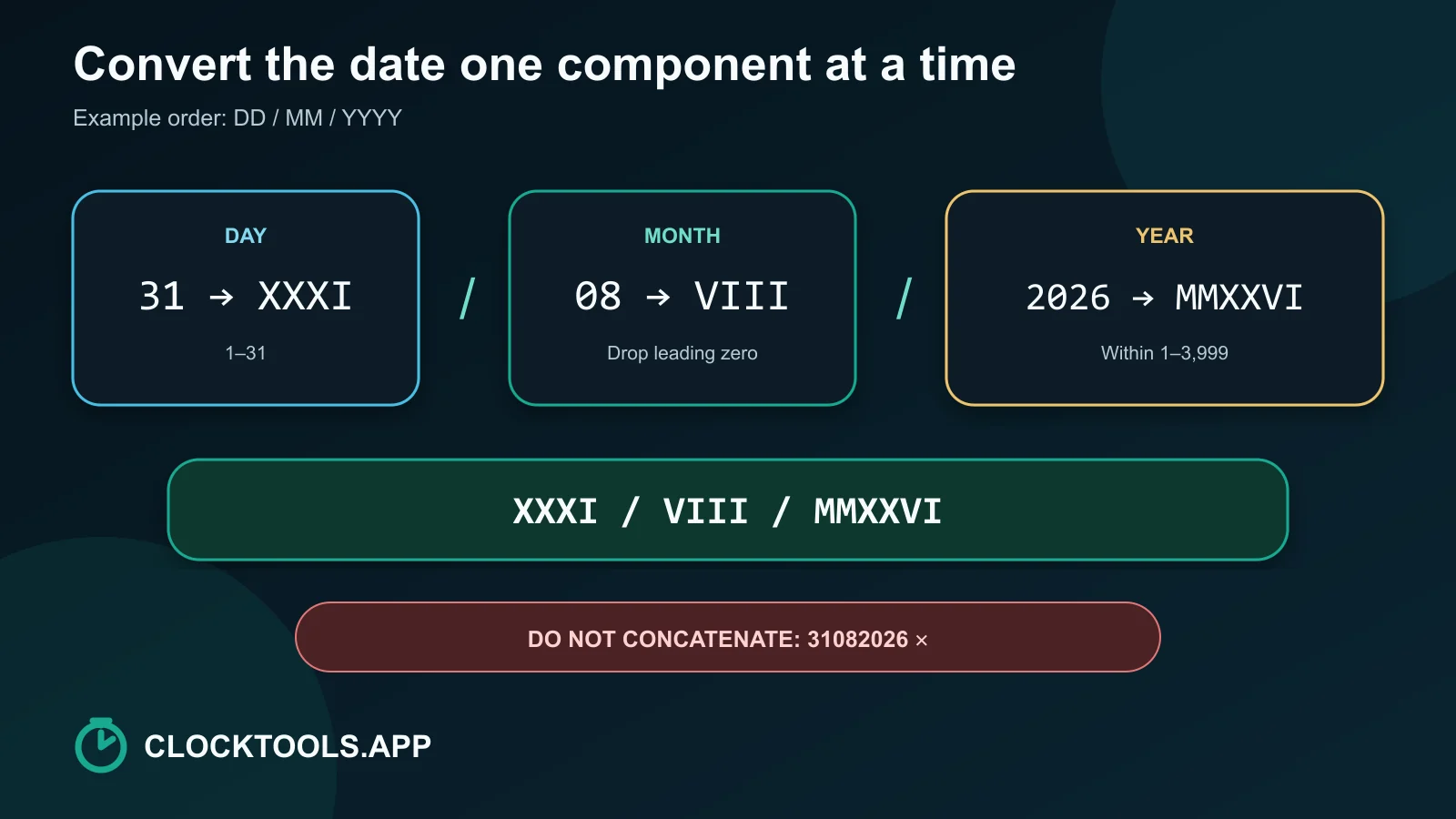
To write a date in Roman numerals, convert the day, month, and year separately, keep the original date order, and preserve a clear separator. For example, 31/08/2026 becomes XXXI/VIII/MMXXVI. Do not concatenate the digits into 31082026 and convert that as one number: it destroys the date's components and exceeds the conventional 1–3,999 range used by the ClockTools Roman Numeral Converter.
What is the safest method?
Use a component-by-component checklist:
- Identify the date's intended order: day-month-year, month-day-year, or year-month-day.
- Split the date into three numeric components.
- Remove leading zeros only for calculation:
08becomes8. - Convert each positive component independently.
- Reassemble the Roman results in the same order with
/,-, or centered dots. - Label the order when an audience could read it differently.
This is a modern display convention, not a single universal Roman dating standard. Historical documents may use regnal years, feast days, calendrical phrases, abbreviations, or Latin grammar. The UK National Archives' guide to dating Latin documents shows how varied historical formulas can be. For a modern engraving, poster, or tattoo, clarity matters more than imitation of an unspecified historical style.
How do you convert 31/08/2026?
Break it into 31, 08, and 2026, then convert each part with the tool:
| Component | Decimal value | Roman numeral | Check |
|---|---|---|---|
| Day | 31 | XXXI | XXX + I |
| Month | 8 | VIII | V + III |
| Year | 2026 | MMXXVI | MM + XX + VI |
Reassemble the parts as XXXI/VIII/MMXXVI. In controlled live tests on 2026-08-31, the converter returned XXXI for 31, VIII for 8, and MMXXVI for 2026. It rejected the concatenated 31082026 with the valid-range instruction, which is the correct safety signal for this workflow.
The same process supports other orders:
| Source format | Roman display | Order label |
|---|---|---|
| 31/08/2026 | XXXI/VIII/MMXXVI | DD/MM/YYYY |
| 08/31/2026 | VIII/XXXI/MMXXVI | MM/DD/YYYY |
| 2026-08-31 | MMXXVI-VIII-XXXI | YYYY-MM-DD |
The symbols alone do not reveal whether VIII/IX/MMXXVI means 8 September or August 9. Preserve or state the source order.
Which date order should you use?
Use the order your intended reader expects, or use year-month-day when a clearly labeled technical sequence is the goal. Roman numerals do not solve numeric-date ambiguity. If the design must travel across countries, add a small DD/MM/YYYY or MM/DD/YYYY label in surrounding copy, or spell the month elsewhere.
For date arithmetic, first verify the source in ordinary digits with a calendar or Date of Birth Calculator. Convert only after the date itself is settled. A visually elegant conversion of the wrong input is still wrong.
How should you handle zero and leading zeros?
Classical Roman numerals have no standard place-value zero. A leading zero in 08 is formatting, not part of the month value, so convert 8 to VIII. Do not invent a leading Roman symbol to preserve the two-character width.
Every ordinary modern calendar component is positive: days 1–31, months 1–12, and a positive year within the converter's supported range. Years described as BCE/CE need an era label outside the numeral. Do not silently convert an astronomical year zero or a negative year.
Which Roman numeral rules does each component follow?
ClockTools uses conventional, canonical forms from 1 through 3,999. The common symbols are I=1, V=5, X=10, L=50, C=100, D=500, and M=1,000. Subtractive pairs keep forms compact: IV=4, IX=9, XL=40, XC=90, CD=400, and CM=900.
That means 49 is XLIX, not IL, and 1999 is MCMXCIX, not MIM. The National Archives' Roman numerals reference is useful for reading additive and subtractive patterns in historical records, where usage can be less uniform. For a modern date, use the converter's canonical output consistently across all components.
How can you verify a date before permanent use?
For an engraving, legal display, memorial, or tattoo, use a two-person check:
- Person A converts each component independently.
- Person B converts each Roman component back to ordinary digits without seeing the source.
- Both compare order, separators, spelling, and the source document.
- A third check confirms the calendar date itself, including leap-day validity where relevant; the Age Calculator can expose an input-order mistake.
Print the final string at actual size before approving fabrication. Letter spacing can make VI look like V I, and decorative fonts can blur I, V, and X. Keep an ordinary-digit version in the production note. The accompanying diagram provides a proof sheet for 31/08/2026 and explicitly shows the invalid concatenation route.
Should you use Unicode Roman numeral characters?
Usually, type ordinary Latin letters: MMXXVI, not compatibility glyphs such as ⅯⅯⅩⅩⅤⅠ. The Unicode Standard's Number Forms guidance says Roman numerals should be composed from appropriate Latin letters for most purposes; the dedicated characters exist mainly for compatibility with East Asian standards.
Latin letters are easier to search, copy, index, and render consistently. If a publisher requires compatibility characters, test the exact font and export pipeline, then retain an accessible Latin-letter or ordinary-digit equivalent.
Frequently Asked Questions
How do you write 31/08/2026 in Roman numerals?
Convert each part and preserve day-month-year order: 31 is XXXI, 8 is VIII, and 2026 is MMXXVI, giving XXXI/VIII/MMXXVI.
Should a Roman numeral date use day first or month first?
Keep the source date's intended order and label it when readers may use another convention. Roman symbols alone do not resolve DD/MM versus MM/DD ambiguity.
Do you convert a whole date as one number?
No. Split the day, month, and year, convert each independently, and then restore separators. Concatenation destroys the component boundaries and often exceeds the standard range.
How do you write a leading zero in Roman numerals?
You do not preserve it. Treat 08 as the value 8 and write VIII because conventional Roman numerals have no positional leading zero.
Can you write a BCE date in Roman numerals?
You can convert the positive year number, but retain the BCE or CE era label outside the numeral. Do not silently invent a Roman zero or negative-year notation.
Should a tattoo use Unicode Roman numeral characters?
Ordinary Latin letters are usually safer for searching, proofing, fonts, and production. Verify the exact final artwork with an independent reverse conversion before permanent use.

About The Author
Vigneshwaran Vijayakumar
Founder, Developer and Publisher of ClockTools | Digital Marketing Manager | India
Vigneshwaran is an engineer with decades of technical experience, including professional work as a Digital Marketing Manager in Dubai. His work connects data analysis, search engine optimization, conversion-rate optimization, content systems, visual production, and applied AI and machine learning. At ClockTools, he turns that multidisciplinary experience into focused browser utilities and practical, source-aware guides.