Phonetic Alphabet Tools
How Do You Pronounce the NATO Phonetic Alphabet?
Use official spellings, practical stress cues, radio-number forms, and a short readback drill to transmit exact characters clearly.
By Vigneshwaran Vijayakumar, Developer and Publisher | | Reviewed under the ClockTools editorial policy
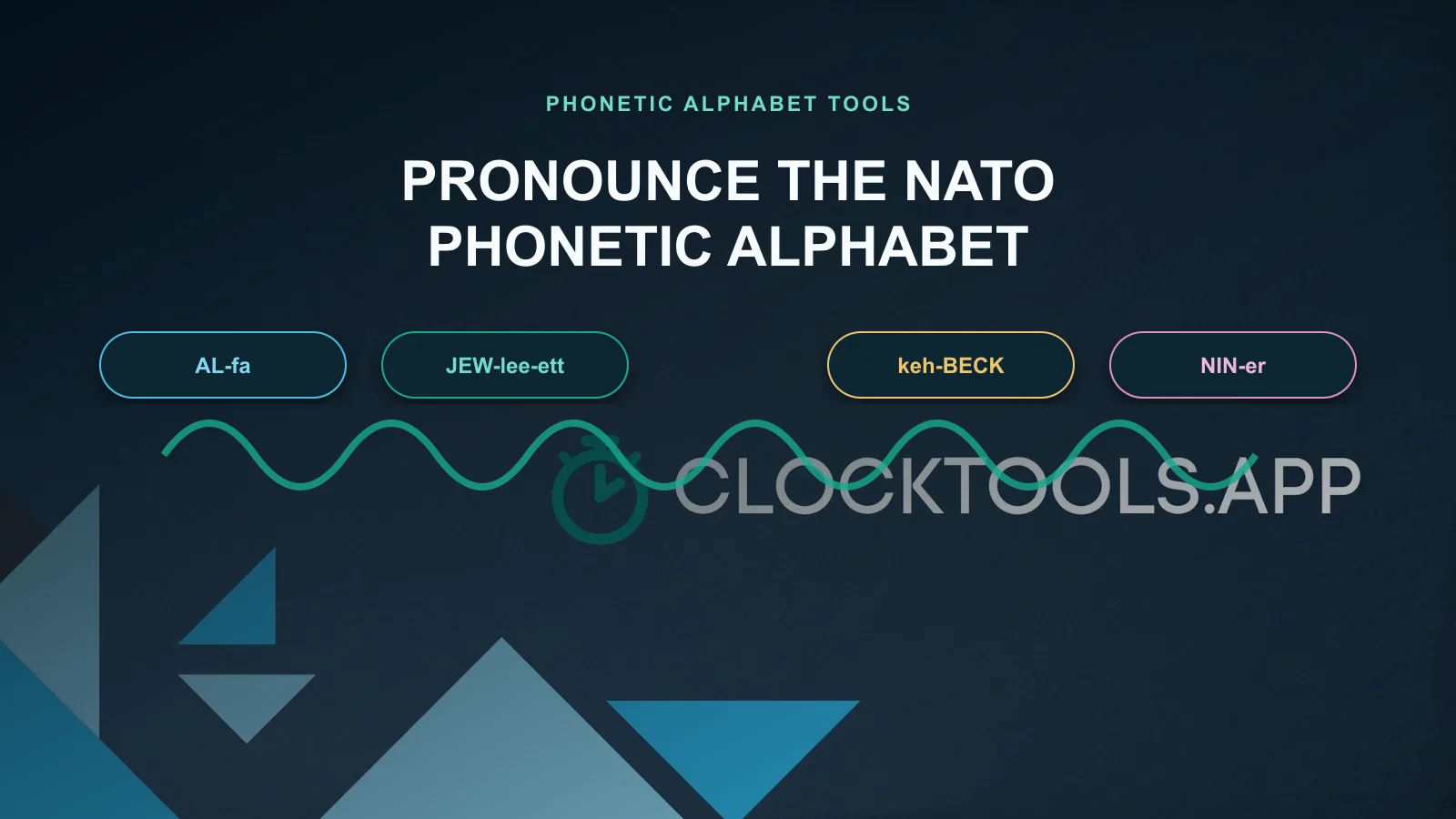
Table of contents
To pronounce the NATO phonetic alphabet clearly, say the official code word for each letter, stress the marked syllable, and leave a small gap before the next code word. Several forms are intentionally international: Alfa, Juliett, X-ray, and Quebec. For digits, radiotelephony forms include Tree, Fower, Fife, Ait, and Niner. The ClockTools NATO phonetic alphabet translator generates the official spellings and lets you rehearse them with browser speech.
What should a clear readback sound like?
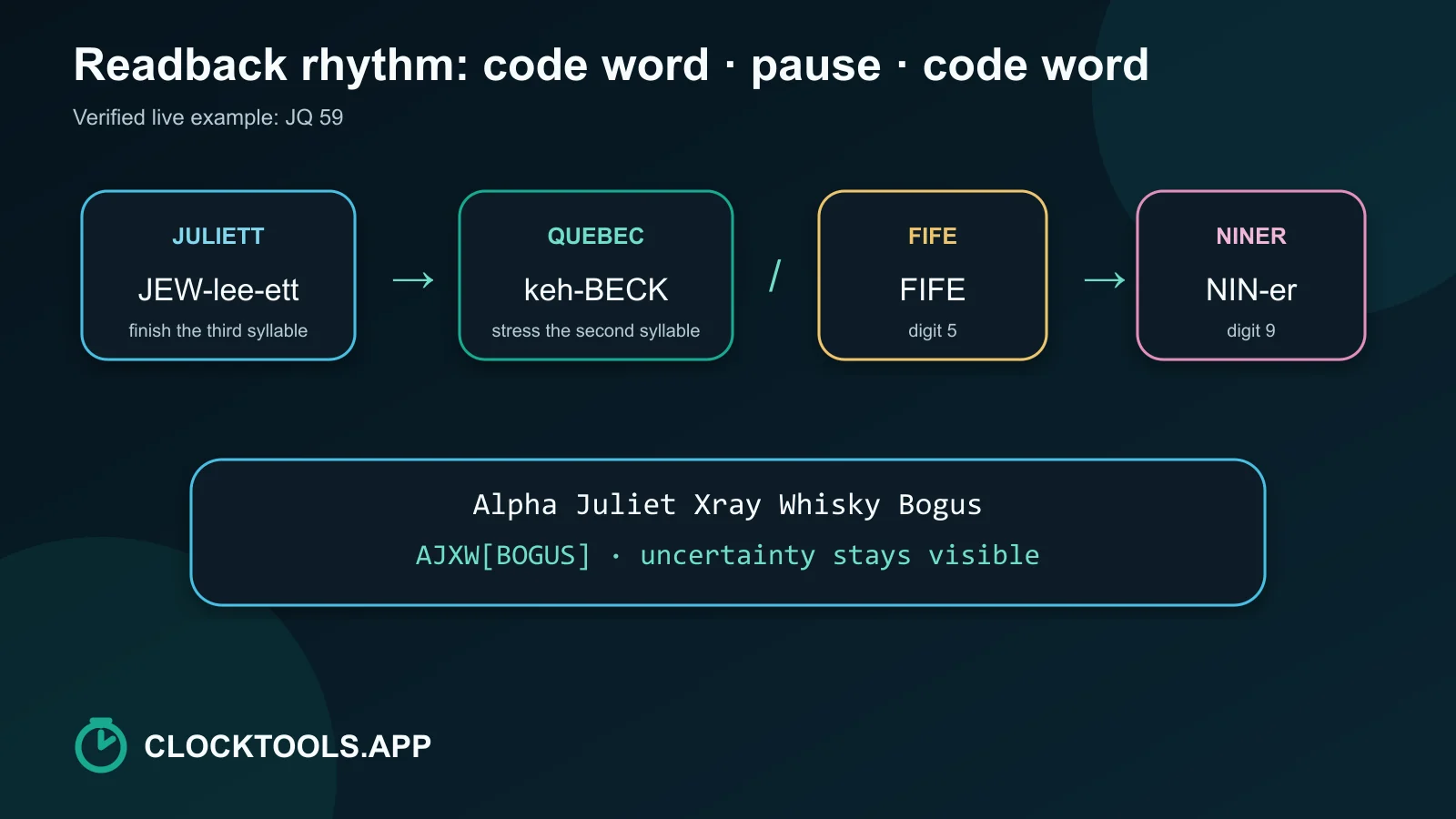
Clarity comes from rhythm more than volume. Read one code word at a steady pace, finish it, pause briefly, and then begin the next. Do not compress several code words into one breath or add creative alternatives. A receiver should be able to count the letters from the spoken units.
For a name or identifier, announce the ordinary form first when the situation allows, then spell only the uncertain portion. A practical pattern is:
“Code JQ five nine: Juliett Quebec Fife Niner.”
The FAA air-traffic-control handbook points readers to the ICAO radiotelephony alphabet and pronunciation tables. The purpose is consistent identification, not imitation of one regional accent. Keep syllables distinct and follow the operational procedure of the service you are using.
How do you pronounce Alfa through Zulu?
The emphasis below uses capital letters for the stressed part. It is a reading aid, not phonetic notation.
| Letter | Code word | Practical pronunciation |
|---|---|---|
| A | Alfa | AL-fah |
| B | Bravo | BRAH-voh |
| C | Charlie | CHAR-lee |
| D | Delta | DELL-tah |
| E | Echo | ECK-oh |
| F | Foxtrot | FOKS-trot |
| G | Golf | GOLF |
| H | Hotel | hoh-TELL |
| I | India | IN-dee-ah |
| J | Juliett | JEW-lee-ett |
| K | Kilo | KEY-loh |
| L | Lima | LEE-mah |
| M | Mike | MIKE |
| N | November | no-VEM-ber |
| O | Oscar | OSS-cah |
| P | Papa | pah-PAH |
| Q | Quebec | keh-BECK |
| R | Romeo | ROW-me-oh |
| S | Sierra | see-AIR-rah |
| T | Tango | TANG-go |
| U | Uniform | YOU-nee-form |
| V | Victor | VIK-tah |
| W | Whiskey | WISS-key |
| X | X-ray | ECKS-ray |
| Y | Yankee | YANG-key |
| Z | Zulu | ZOO-loo |
NATO's archived 1956 pronunciation memorandum documents the pronunciation standard's early formal use. Modern operational tables should remain the reference for a regulated aviation, maritime, military, or public-safety setting.
Which words cause the most hesitation?
Four entries deserve deliberate practice:
- Alfa uses the official international spelling with
f, not the common English spelling “Alpha.” - Juliett has two final
tletters in the official form. - Quebec is stressed on the second syllable:
keh-BECK. - Papa is stressed on the second syllable:
pah-PAH.
Uniform, Sierra, and X-ray also become muddy when rushed. Give each syllable its space. The first letter remains the information being transmitted; the word is the error-resistant envelope around it.
The spelling alphabet is not a general pronunciation dictionary. “Oscar” represents the letter O even if a speaker's everyday pronunciation of the name differs. Consistency across speakers matters more than local naturalness.
How are numbers pronounced over radio?
The ClockTools chart uses clearer radiotelephony forms for the digits that are most easily clipped or confused:
| Digit | Radio form | Pronunciation cue |
|---|---|---|
| 0 | Zero | ZEE-roh |
| 1 | One | WUN |
| 2 | Two | TOO |
| 3 | Tree | TREE |
| 4 | Fower | FOW-er |
| 5 | Fife | FIFE |
| 6 | Six | SIX |
| 7 | Seven | SEV-en |
| 8 | Ait | AIT |
| 9 | Niner | NIN-er |
Say a multi-digit identifier one digit at a time unless the governing procedure requires another format. 59 becomes Fife Niner, not “fifty-nine.” This keeps a receiver from guessing whether the message names a number, a quantity, or two individual identifier characters.
What did the translator produce in a live test?
In a controlled test on 2026-09-01, entering JQ 59 with Radio Numbers enabled produced:
Juliett Quebec / Fife Niner
The slash marked the word boundary. The same tool displayed the pronunciation chart beside the conversion, so the spelling and stress cue could be checked without leaving the working surface.
A reverse-direction test used Alpha Juliet Xray Whisky Bogus. The decoder accepted the common variants and returned AJXW[BOGUS], with a visible warning that Bogus was not recognized. This is a useful failure behavior: uncertain input remains visible instead of disappearing and silently changing the message length.
Browser speech can help with rehearsal, but its voice and accent come from the browser and operating system. Treat playback as practice support, not as proof that a regulated readback meets an organization's training standard.
How can you practice a message in three passes?
Use a short, repeatable drill:
- Map: type a name, call sign, registration, or reference into the translator and compare every generated code word with the chart.
- Speak: read the sequence slowly, using one breath group for three or four code words rather than racing through the entire line.
- Recover: ask another person to repeat the ordinary letters, or swap to Phonetic To Text and enter the words you remember.
Start with a five-character string that mixes letters and digits. Move to longer messages only after the receiver can reproduce the short string accurately. Record unfamiliar words in the Online Notepad, then revisit only that subset rather than drilling all 26 entries every time.
For a contrast exercise, use the Morse Code Converter. A spelling alphabet sends spoken words; Morse code sends timed signal patterns. Practicing the distinction prevents a learner from treating the two systems as interchangeable encodings.
Which pronunciation habits reduce clarity?
| Habit | Why it fails | Better action |
|---|---|---|
| Inventing a word such as “B for banana” | The receiver may not expect it | Use Bravo |
| Saying letter names between every code word | It doubles the message and breaks rhythm | Announce the format once, then read code words |
| Rushing the final syllable | Distinctive sound is lost | Finish the word before the pause |
| Treating 59 as “fifty-nine” | The receiver may infer a quantity | Say Fife Niner for an identifier |
| Ignoring an unknown decoder token | A character may be lost | Stop, repeat, and resolve the bracketed token |
| Trusting synthetic speech as certification | Voice output varies by platform | Follow the applicable official training table |
The best readback is uneventful: standard words, even spacing, visible uncertainty, and a receiver who can reconstruct the exact characters without asking which improvised example you meant.
Frequently Asked Questions
Is it Alfa or Alpha in the NATO alphabet?
The official international spelling is Alfa with an f. ClockTools generates Alfa while accepting Alpha as a common typed variant during decoding.
Why is Juliett spelled with two t letters?
Juliett is the official international spelling. The standardized form supports consistent pronunciation across languages, while the decoder can still accept Juliet as a common variant.
How do you pronounce Quebec in the NATO alphabet?
Use two distinct syllables with stress on the second: keh-BECK.
How do you say the number 9 over radio?
The radiotelephony form is Niner, pronounced NIN-er. Multi-digit identifiers are normally read one digit at a time unless the applicable procedure says otherwise.
Can browser speech teach the official pronunciation?
It can support rehearsal, but the voice and accent depend on the browser and operating system. Use the applicable official table and training for regulated communication.
Is the NATO phonetic alphabet the same as Morse code?
No. The phonetic alphabet represents letters with spoken code words; Morse code represents them with timed dots and dashes sent through sound, light, tone, or tapping.

About The Author
Vigneshwaran Vijayakumar
Founder, Developer and Publisher of ClockTools | Digital Marketing Manager | India
Vigneshwaran is an engineer with decades of technical experience, including professional work as a Digital Marketing Manager in Dubai. His work connects data analysis, search engine optimization, conversion-rate optimization, content systems, visual production, and applied AI and machine learning. At ClockTools, he turns that multidisciplinary experience into focused browser utilities and practical, source-aware guides.