Weather Calculator Tools
How to Calculate Wind Chill
A step-by-step guide to the official wind chill equation, including a 30 F and 10 mph example, unit conversions, limits, and interpretation.
By Vigneshwaran Vijayakumar, Developer and Publisher | | Reviewed under the ClockTools editorial policy
Table of contents
To calculate wind chill with the official U.S. formula, enter the air temperature in degrees Fahrenheit and wind speed in miles per hour:
Wind chill (F) = 35.74 + 0.6215T - 35.75V^0.16 + 0.4275T(V^0.16)T is air temperature in Fahrenheit and V is wind speed in miles per hour. The formula is defined for air temperatures at or below 50 F and wind speeds above 3 mph. Outside that range, reporting a calculated wind chill would give the equation a meaning it was not designed to have.
The ClockTools Wind Chill Calculator handles the unit conversions and applicability check automatically. This guide shows the calculation behind the result so you can verify it by hand or in a spreadsheet.
How do you calculate wind chill?
You need two observations: the actual air temperature and the wind speed. Use a temperature measured away from direct heat sources and a wind speed appropriate to the location. Then follow these steps:
- Convert the temperature to Fahrenheit if necessary.
- Convert the wind speed to miles per hour.
- Confirm that
T <= 50 FandV > 3 mph. - Calculate
V^0.16, which means raise the wind speed to the power 0.16. - Substitute
T,V^0.16, andT(V^0.16)into the equation. - Round only the final result to the precision you need.
The order matters. V^0.16 is not V x 0.16, and the final term multiplies temperature by that powered wind value. A calculator with an exponent key, a spreadsheet, or ClockTools can evaluate the expression directly.
What is the official wind chill formula?
The National Weather Service wind chill chart publishes the Fahrenheit and miles-per-hour equation used above. In expanded form, its four terms are:
| Term | Expression | Role in the model |
|---|---|---|
| Constant | 35.74 | Baseline coefficient |
| Temperature term | 0.6215T | Adds the air-temperature contribution |
| Wind term | -35.75V^0.16 | Accounts for cooling associated with wind |
| Interaction term | +0.4275T(V^0.16) | Adjusts how temperature and wind act together |
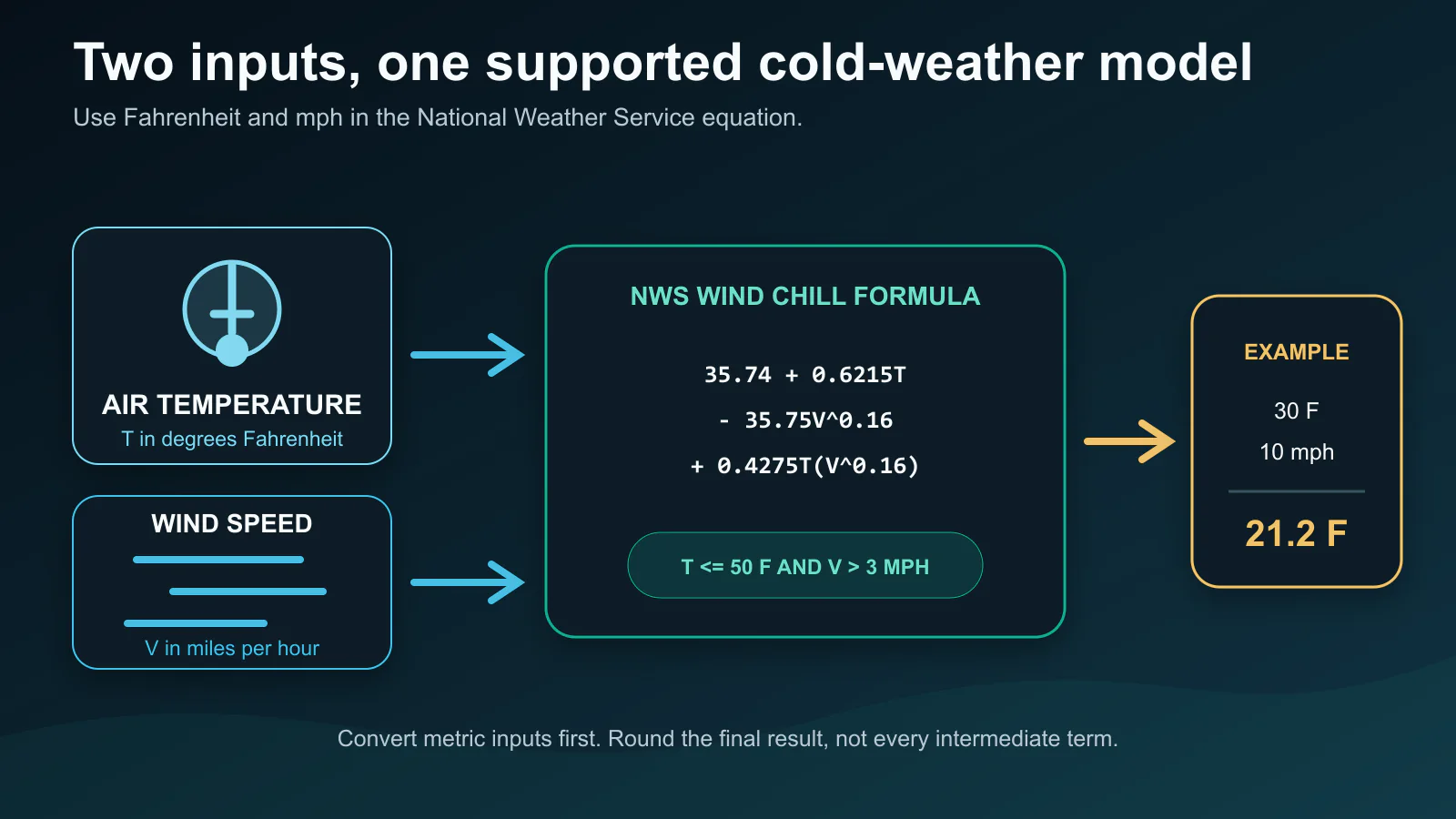
The coefficients belong to this exact combination of units. Inserting Celsius or kilometers per hour directly into the Fahrenheit formula produces the wrong result. Convert first, or use the metric form implemented by a trusted calculator.
The National Weather Service also provides an official meteorological calculator collection for checking weather-unit and index calculations. Keep the formula source and the observations together when the result is used in a report or worksheet.
How does a worked example produce 21.2 F?
Suppose the air temperature is 30 F and wind speed is 10 mph. Both inputs are inside the formula's supported range.
First calculate the powered wind term:
10^0.16 = 1.4454 approximatelyNow substitute the values without rounding the intermediate terms too aggressively:
Wind chill = 35.74 + (0.6215 x 30)
             - (35.75 x 10^0.16)
             + (0.4275 x 30 x 10^0.16)

Wind chill = 21.248... F
Rounded to one decimal place, the wind chill is 21.2 F, or about -6.0 C. The air has not cooled to 21.2 F. The result describes how the combination of cold air and moving wind increases heat loss from exposed skin compared with calmer conditions.
If your hand result differs by a few tenths, check when you rounded V^0.16. Keeping more digits until the last step usually resolves the difference.
When should the formula not be used?
The U.S. wind chill equation is intended for temperatures at or below 50 F and wind speeds above 3 mph. The ClockTools implementation follows those boundaries. When the formula does not apply, the tool reports the air temperature rather than presenting a misleading wind chill calculation.
That creates two useful edge checks:
- At 55 F with a 20 mph wind, do not use this cold-weather wind chill formula.
- At 30 F with a 2 mph wind, the wind threshold is not met, so report the air temperature.
Wind chill is also not the correct index for hot, humid conditions. Use the Heat Index Calculator when temperature and humidity combine to increase heat stress. Use the Dew Point Calculator when you need a measure tied to atmospheric moisture and condensation.
How do you use Celsius and kilometers per hour?
You can convert metric observations before applying the Fahrenheit formula:
F = (C x 9/5) + 32
mph = km/h / 1.609344
C = (F - 32) x 5/9
For meters per second, multiply by approximately 2.236936 to obtain miles per hour. For knots, multiply by approximately 1.150779. Keep adequate precision during conversion and round the final wind chill result.
| Input unit | Convert to formula unit |
|---|---|
| Celsius | (C x 9/5) + 32 |
| Kilometers per hour | km/h / 1.609344 |
| Meters per second | m/s x 2.236936 |
| Knots | knots x 1.150779 |
ClockTools accepts Celsius or Fahrenheit for temperature and mph, km/h, m/s, or knots for wind speed. It converts internally, evaluates the supported equation, and returns the result in the selected display unit.
What do sample wind chill values show?
The following values come from the same formula and are rounded to one decimal place. They are examples, not a forecast for a specific place.
| Air temperature | Wind speed | Calculated wind chill |
|---|---|---|
| 40 F | 5 mph | 36.5 F |
| 30 F | 10 mph | 21.2 F |
| 20 F | 20 mph | 4.2 F |
| 0 F | 15 mph | -19.4 F |
| -10 F | 30 mph | -39.4 F |
Two patterns stand out. First, colder air produces a colder result when wind is held constant. Second, increasing wind usually lowers the wind chill, but the relationship is not linear because the equation uses V^0.16. Doubling wind speed does not simply double the cooling effect.
The NWS chart combines temperatures and wind speeds into a readable grid and includes frostbite-risk guidance. Use the current NWS wind chill safety page for official U.S. weather-safety information rather than inferring exposure time from the equation alone.
What does wind chill actually measure?
Wind chill is an index of heat loss from exposed skin under specified conditions. Moving air carries heat away from the body more quickly than calm air, so the cold can feel more severe. The NWS explains that the model assumes no impact from the sun; bright sunshine can make conditions feel warmer than the calculated value.
The result does not mean an inanimate object will cool below the actual air temperature solely because of wind. Wind can make the object reach air temperature faster, but a wind chill of 10 F with an actual temperature of 25 F does not drive the object to 10 F.
Clothing, moisture, activity, shelter, body size, health, and local gusts affect a person's experience. The formula intentionally compresses complex conditions into one comparable index. Treat it as a planning signal, not a personalized medical prediction.
How can ClockTools check the calculation?
Open the online wind chill calculator, select the units printed on your weather observation, and enter the temperature and wind speed. The result updates with the apparent temperature, temperature difference, applicability status, and practical context.
For the worked example, enter 30 Fahrenheit and 10 mph. The displayed result should round to about 21.2 F. Switching the output to Celsius should show about -6.0 C without changing the underlying conditions.
Use the information buttons when a unit or weather term is unfamiliar. They explain the role of the field without forcing more text into the primary calculator area. This keeps the main workflow compact on mobile while preserving the detail needed to interpret the answer.
What safety limits should you remember?
Weather observations can change quickly, and one average wind speed may not capture exposed ridges, open water, vehicle travel, or local gusts. Check an official forecast and warnings before outdoor activity. Cover exposed skin, keep clothing dry, and plan a warm shelter or shorter exposure when conditions deteriorate.
Wind chill values and frostbite guidance do not diagnose frostbite or hypothermia. Shivering, numbness, confusion, slurred speech, or unusual drowsiness can require urgent action. Follow local emergency guidance and seek qualified medical help when symptoms or exposure are serious.
For calculation work, preserve the original observations, units, and time. A result without its input units is easy to misread. The best record is not just "wind chill 21" but "30 F, 10 mph, wind chill 21.2 F, calculated with the NWS formula."
Frequently Asked Questions
What is the formula for calculating wind chill?
For Fahrenheit and mph, the NWS formula is 35.74 + 0.6215T - 35.75V^0.16 + 0.4275T(V^0.16), where T is air temperature in Fahrenheit and V is wind speed in mph.
When does the wind chill formula apply?
The U.S. formula is defined for air temperatures at or below 50 F and wind speeds above 3 mph. Outside those conditions, the ClockTools calculator reports the air temperature instead of applying the formula.
What is the wind chill at 30 F and 10 mph?
Using the NWS formula, 30 F with a 10 mph wind produces approximately 21.2 F, which is about -6.0 C.
Can I enter Celsius and kilometers per hour?
Yes. ClockTools accepts Celsius or Fahrenheit and several wind units. For a manual Fahrenheit calculation, convert Celsius and kilometers per hour before substituting the values.
Does wind chill lower the actual air temperature?
No. Wind chill describes increased heat loss from exposed skin. Wind can make an object reach air temperature faster, but it does not cool the object below the actual air temperature by itself.
Does sunshine affect the wind chill result?
The NWS model assumes no impact from the sun. Direct sunshine can make conditions feel warmer than the calculated wind chill, while shade, moisture, clothing, and local gusts also affect experience.

About The Author
Vigneshwaran Vijayakumar
Founder, Developer and Publisher of ClockTools | Digital Marketing Manager | India
Vigneshwaran is an engineer with decades of technical experience, including professional work as a Digital Marketing Manager in Dubai. His work connects data analysis, search engine optimization, conversion-rate optimization, content systems, visual production, and applied AI and machine learning. At ClockTools, he turns that multidisciplinary experience into focused browser utilities and practical, source-aware guides.