Creator Tools
How Much Does YouTube Pay for 1 Million Views?
A scenario-based answer for one million YouTube views using transparent RPM arithmetic instead of a universal payout claim.
By Vigneshwaran Vijayakumar, Developer and Publisher | | Reviewed under the ClockTools editorial policy
Table of contents
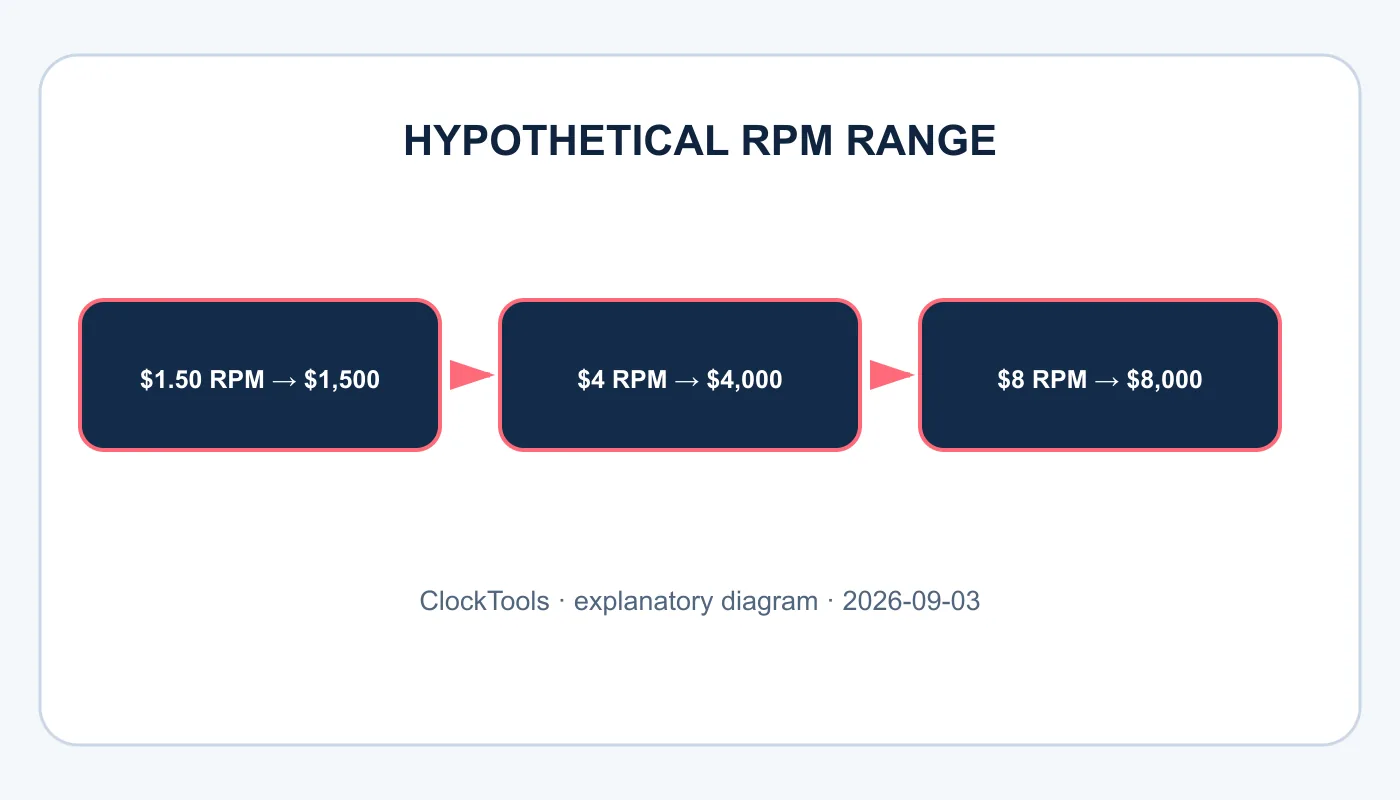
YouTube does not have one fixed payment for one million views. The auditable calculation is views ÷ 1,000 × RPM, using an RPM from the same format and reporting period. At exactly one million views, every $1 of RPM corresponds to $1,000 of estimated revenue: $1.50 RPM implies $1,500, $4 RPM implies $4,000, and $8 RPM implies $8,000. These are scenarios, not a YouTube rate card or income guarantee.
What is the shortest honest answer?
Multiply one thousand by the relevant RPM. One million views contain one thousand groups of one thousand views, so the calculation collapses to a simple sensitivity table.
| Hypothetical RPM | Revenue at 1,000,000 views |
|---|---|
| $1.50 | $1,500 |
| $4.00 | $4,000 |
| $8.00 | $8,000 |
The table does not claim that any channel will receive those rates. YouTube’s partner earnings overview says there are no guarantees about how much or whether a creator will be paid. The creator’s own Analytics report is stronger evidence than a public calculator or a niche benchmark.
How does RPM turn views into revenue?
RPM means revenue per mille—revenue per one thousand views. The general formula is:
estimated revenue = total views ÷ 1,000 × RPM
For 1,000,000 views at $3.25 RPM, divide by 1,000 to get 1,000 units, then multiply by $3.25. The result is $3,250. At 100,000 views, the same RPM would produce $325 because there are only 100 thousand-view units.
Keep the view total and RPM in the same period. A monthly RPM applied to one video’s lifetime views mixes two different populations. Also confirm whether the reported metric is for videos or Shorts; YouTube now calculates Shorts RPM using engaged views for Shorts revenue sharing.
Why should you not multiply CPM by every view?
CPM answers an advertiser-side question. RPM answers a creator-side revenue question. According to YouTube’s revenue analytics documentation, CPM represents advertiser cost per thousand ad impressions before revenue share, while RPM reflects creator revenue after revenue share and uses the relevant total views.
Not every public view produces an ad impression. A viewer may receive no ad, use YouTube Premium, watch in a market with different demand, or view content with limited monetization. RPM can also include revenue sources such as memberships, Premium, Super Chat, and Super Stickers, so it is not simply CPM minus one percentage.
That is why public views ÷ 1,000 × public CPM can look precise while answering the wrong question. Use CPM to investigate advertiser demand; use actual RPM to forecast creator revenue.
What did the ClockTools scenario show?
I ran the live YouTube Revenue Calculator with its default global, long-form assumptions. At one million monthly views, it displayed a $4,000 typical monthly estimate and a range from $1,500 to $8,000, corresponding to visible RPM assumptions of $1.50, $4.00, and $8.00.
Then I changed only views to 100,000. The displayed midpoint became $400 and the range became $150 to $800. That tenfold reduction is the expected linear result when the RPM assumptions remain fixed.
This test verifies calculator arithmetic and range presentation; it does not validate the default RPMs for a particular channel. The useful feature is that the assumptions stay visible. A creator can replace the defaults with channel evidence instead of treating the midpoint as a prediction.
Which RPM belongs in the forecast?
Choose the narrowest reliable RPM that matches the decision.
| Forecast question | Better RPM source | Avoid |
|---|---|---|
| Next month for an established channel | Several comparable recent months in the owner’s Analytics | One viral week |
| One long-form series | Similar long-form videos and audience mix | Channel-wide Shorts-heavy RPM |
| A Shorts plan | Shorts RPM for a matching period | Long-form RPM |
| A channel you do not own | Labelled low/mid/high assumptions | Claiming verified income from public views |
YouTube Analytics can be opened at channel or video level, and its Revenue tab is the source for eligible creators’ estimated revenue. Use a period long enough to reduce one-off noise, but do not blend materially different formats just to create a bigger sample.
Record the source period, format, currency, view definition, and whether the RPM includes non-ad revenue. Without those labels, another person cannot reproduce the estimate.
How do Shorts change the estimate?
Shorts and watch-page videos have different revenue-sharing systems. YouTube’s earnings overview describes a Watch Page Monetization Module and a separate Shorts Monetization Module. A million Shorts engaged views should therefore not inherit the RPM of a long-form library.
When the channel is mixed, split the forecast if you can: estimate long-form views with a comparable long-form RPM and Shorts engaged views with a comparable Shorts RPM, then add the results. A single blended RPM is acceptable for a high-level channel plan only when the format mix is expected to remain similar.
Also separate platform revenue from sponsorships, affiliate income, products, and licensing. Those can matter greatly to a creator business, but adding them silently to an RPM-based answer makes the one-million-view figure impossible to audit.
How should you report a one-million-view estimate?
Use a sentence that exposes the assumption: “At one million views and a hypothetical $2–$6 RPM, the modeled revenue range is $2,000–$6,000 before taxes and any separately tracked off-platform income.” This states the math without pretending the range belongs to every creator.
Save the scenario alongside its evidence date and source. The online notepad is enough for a small assumption log; the Pomodoro timer can help when you need a bounded review session for several videos. Revisit the range after Analytics finalizes or the format mix changes.
Before sharing, ask four questions: Does the RPM come from the same format? Do the views cover the same period? Are currency and revenue sources clear? Is the result labelled as an estimate? If any answer is no, fix the inputs or lower the confidence instead of adding decimals.
Frequently Asked Questions
Is there a fixed YouTube payment for one million views?
No. YouTube says earnings are not guaranteed, and revenue depends on monetization, format, audience, advertiser demand, revenue sources, and the creator’s actual RPM.
How do I calculate revenue from RPM?
Divide total views by 1,000 and multiply by RPM. At one million views, each $1 of RPM corresponds to $1,000 in estimated revenue for the same reporting period.
Should I use RPM or CPM to estimate creator revenue?
Use RPM when possible because it is creator-focused, after revenue share, and based on all relevant views for the metric. CPM is advertiser-focused and does not map directly to creator take-home revenue.
Do Shorts and long-form views earn the same amount?
They use different viewing and revenue-sharing systems, so do not apply a long-form RPM to a Shorts-heavy view total. Use the RPM for the same format and period you are forecasting.
Can public channel views reveal verified income?
No. Public views do not expose private RPM, monetized playback share, claims, memberships, Premium revenue, adjustments, or final payments.
Where can a creator find actual RPM?
Eligible creators can review revenue metrics in YouTube Studio Analytics. Match the view and revenue period before using that RPM in a forecast.

About The Author
Vigneshwaran Vijayakumar
Founder, Developer and Publisher of ClockTools | Digital Marketing Manager | India
Vigneshwaran is an engineer with decades of technical experience, including professional work as a Digital Marketing Manager in Dubai. His work connects data analysis, search engine optimization, conversion-rate optimization, content systems, visual production, and applied AI and machine learning. At ClockTools, he turns that multidisciplinary experience into focused browser utilities and practical, source-aware guides.