Speedometer Tools
GPS Speedometer vs Car Speedometer: Which Is More Accurate?
A measurement-first comparison of phone GPS speed and a vehicle dashboard, including signal limits, tire effects, and a safe test protocol.
By Vigneshwaran Vijayakumar, Developer and Publisher | | Reviewed under the ClockTools editorial policy
Table of contents
A phone GPS speedometer can be a useful estimate of ground speed during steady travel under open sky, while a vehicle speedometer usually remains more continuous in tunnels, garages, and dense streets. Neither reading is universally “the accurate one.” They measure speed through different chains, fail for different reasons, and may update at different rates.
Use the ClockTools GPS speedometer as an independent diagnostic display, not as a certified instrument or permission to exceed a limit. Compare only when a passenger can operate the phone, the vehicle is moving steadily, the sky view is clear, and local law allows the setup.
How do the two speedometers measure different things?
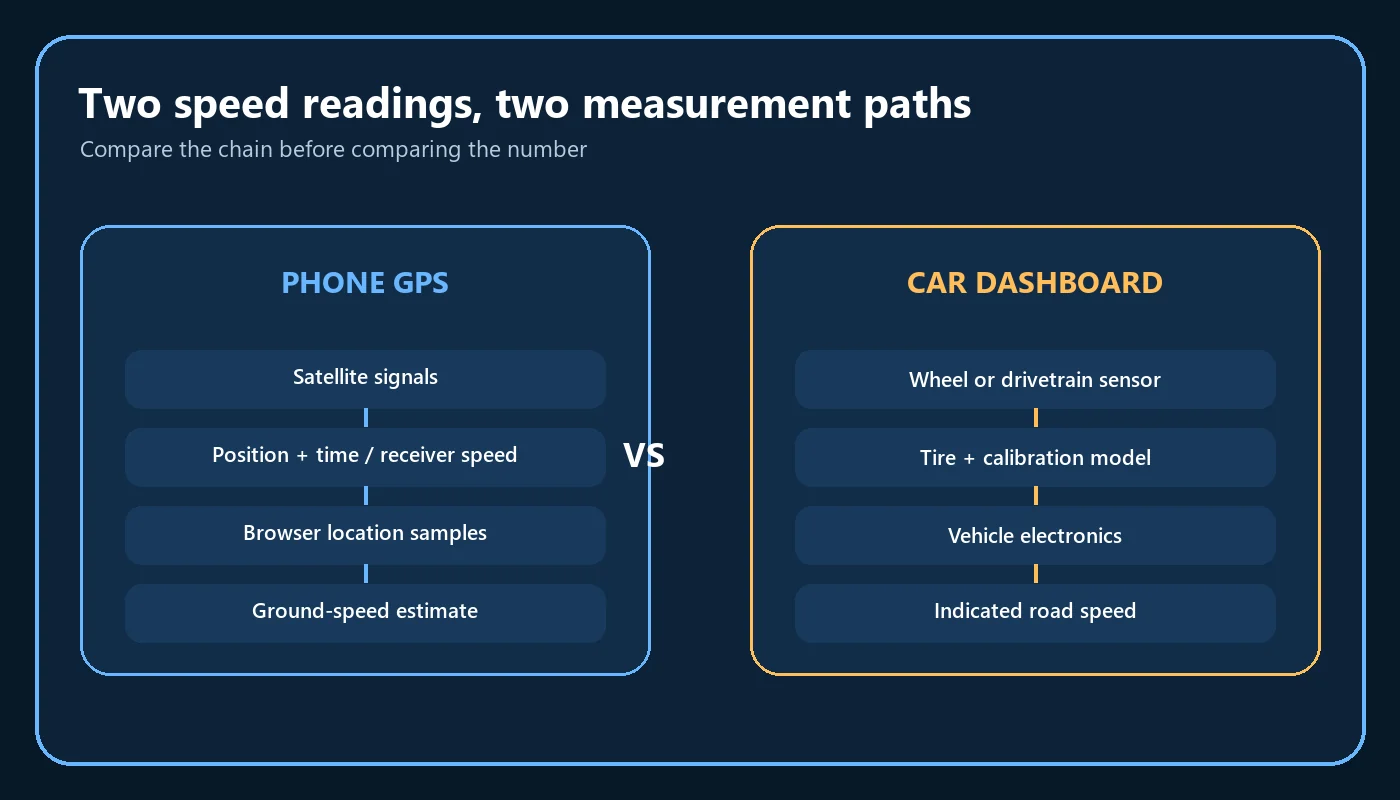
A vehicle speedometer normally starts with rotation. A wheel, gearbox, or related sensor produces a rate; the vehicle converts that rate using its configured tire or drivetrain dimensions and displays a speed. Tire circumference therefore matters. Pressure, wear, a non-standard tire size, or an incorrect calibration can shift the relationship between rotation and actual distance traveled.
A phone GPS receiver starts with satellite signals. The receiver solves for position and time and may provide a direct speed estimate. A browser can expose that value through the Geolocation API. If the device does not provide speed, software can estimate it from the distance between successive positions divided by elapsed time.
The archived GPS.gov accuracy overview explains that the received result depends on satellite geometry, signal blockage, atmospheric conditions, and receiver design. Its published signal-in-space performance is not the same thing as the accuracy of a particular phone in a particular street.
Why can a dashboard read higher than GPS?
Part of the difference can be intentional. Under UN Regulation No. 39, the indicated speed for covered vehicle approvals must not be lower than true vehicle speed, and the allowed upper relationship includes a positive margin. That rule does not prove that every car everywhere follows the same regulation, but it shows why an approved display may be designed not to under-read.
Mechanical inputs add variation. A smaller effective tire circumference makes the wheel complete more rotations over the same road distance and can push an indicated speed upward. A larger circumference can move it the other way. Tire changes should follow the vehicle manufacturer's approved sizes; this article is not a calibration procedure.
GPS has a different bias profile. At steady speed, several good samples can converge on a useful ground-speed estimate. During acceleration, braking, or a short sample gap, the GPS display and dashboard may represent slightly different moments. Comparing a rapidly changing needle with a delayed digital update creates an apparent disagreement even when both systems are behaving normally.
When does GPS speed become unreliable?
Use the environment as the first diagnostic:
| Environment or motion | GPS expectation | Dashboard expectation | Better interpretation |
|---|---|---|---|
| Straight, steady travel under open sky | Often stable after a fix | Stable | Compare several readings, not one instant |
| Dense buildings or tree cover | Reflections and blockage may add noise | Stable if vehicle system is healthy | Give less weight to GPS jumps |
| Tunnel or underground garage | May freeze, disappear, or become stale | Usually continues | Do not treat stale GPS as current speed |
| Strong acceleration or braking | Update timing can lag the moment | Faster local response | Wait for a steady segment |
| Walking or very low speed | Position wander is large relative to movement | Not applicable | Expect noisy zero-to-low values |
GPS.gov lists buildings, bridges, trees, indoor use, and reflected signals as common causes of degraded position accuracy. Speed accuracy also depends on conditions beyond the satellite signal itself. The accuracy radius shown by a phone is a clue about position quality, not a guarantee that the displayed speed has the same numerical error.
What does ClockTools do with location samples?
The live page exposes KM/H, MPH, knots, and meters per second, plus maximum speed, average moving speed, distance, elapsed time, location accuracy, heading, altitude, and sample count. That makes it possible to interpret the reading rather than stare at one large number.
ClockTools requests high-accuracy updates with a short cache allowance and a bounded wait for a location fix. The MDN Geolocation guide confirms that watchPosition() can request repeated positions and that each position may include speed, heading, and accuracy information.
When the browser supplies a valid non-negative speed, ClockTools uses it. When speed is missing, the tool measures distance between consecutive fixes and divides by elapsed time. It treats movement smaller than an accuracy-aware threshold as zero and ignores very long gaps for movement accumulation. This reduces obvious stationary drift, but it cannot manufacture a clean signal from poor source positions.
The accelerator control is explicitly a visual demo. It is useful for checking the gauge animation and theme, not for validating GPS accuracy, distance, or a real trip. Start GPS and grant location permission for live measurement.
How can you compare the readings safely?
Have a passenger handle the device, or mount it before moving and do not interact while driving. Start with the same units on both displays. Wait for a GPS fix in an open area, then choose a straight, level segment where a legal speed can be held steadily.
Record three pairs of readings several seconds apart. Also note the reported GPS accuracy, sky obstruction, tire size, and whether the car was accelerating. Repeat in the opposite direction if safe; a slope, wind, or route does not directly change the basic measurement definitions, but a second run helps expose a non-steady comparison.
Do not average a missing GPS value as zero. Do not compare the dashboard's peak during acceleration with a later GPS update. Do not use the visual accelerator demo as data. The useful artifact is a small test log with context, not a screenshot of one unexplained number.
If you need the location behind a questionable sample, the latitude and longitude checker can help inspect a coordinate separately. Keep any location record private unless sharing is necessary.
What should you conclude from a disagreement?
A small, consistent dashboard-high difference during steady open-sky travel can be compatible with ordinary vehicle calibration and regulation. A GPS value that jumps only beside tall buildings points toward signal conditions. A difference that changes after tire replacement points toward the rotational measurement chain. None of those patterns proves the exact error without a traceable reference instrument.
For maintenance, inspection, insurance, or legal questions, use the manufacturer's documentation and a qualified service or calibrated test. A consumer phone and browser are excellent for noticing a pattern and describing the conditions. They are not a substitute for certified measurement.
The practical answer is conditional: trust the dashboard for continuous in-vehicle awareness, treat a stable open-sky GPS value as an independent comparison, and investigate context before declaring one display wrong.
Frequently Asked Questions
Is GPS speed always more accurate than a car speedometer?
No. GPS can be a strong independent estimate during steady travel under open sky, but it can degrade near buildings, trees, tunnels, or poor satellite geometry. A functioning dashboard remains continuous when GPS is unavailable.
Why does my dashboard show a higher speed than GPS?
Vehicle speed is derived from wheel or drivetrain measurements and calibration. Tire dimensions, pressure, wear, and regulatory design margins can make the displayed value higher than GPS ground speed.
Why is a phone GPS speedometer unreliable indoors?
Satellite signals are weakened or blocked indoors, and a stationary indoor device cannot provide a meaningful travel-speed reading. Move to an open-sky location and wait for a fresh fix.
Does ClockTools read speed directly from GPS?
It uses the browser's reported speed when available. When that value is absent, it can estimate speed from the distance and elapsed time between consecutive location samples while filtering small movements against reported accuracy.
Why does GPS speed jump at low speed?
Small position errors become a large proportion of a short movement. Reflections, blockage, sample timing, and receiver quality can make consecutive fixes wander even when actual speed is low.
Should I use a phone GPS reading to challenge a speeding measurement?
No. A consumer browser reading is diagnostic, not a certified legal instrument. Follow local law and use qualified inspection or calibration services for a disputed vehicle instrument.

About The Author
Vigneshwaran Vijayakumar
Founder, Developer and Publisher of ClockTools | Digital Marketing Manager | India
Vigneshwaran is an engineer with decades of technical experience, including professional work as a Digital Marketing Manager in Dubai. His work connects data analysis, search engine optimization, conversion-rate optimization, content systems, visual production, and applied AI and machine learning. At ClockTools, he turns that multidisciplinary experience into focused browser utilities and practical, source-aware guides.