Date Calculator Tools
Running Age vs. Completed Age: What Is the Difference?
Completed age counts full years already lived. Running age usually names the year of life underway. See the difference with a birthday timeline and worked examples.
By Vigneshwaran Vijayakumar, Developer and Publisher | | Reviewed under the ClockTools editorial policy
Table of contents
Suppose someone was born on November 17, 2001. On August 26, 2026, they have finished 24 full years of life. That makes their completed age 24. They are already living through the next year—the stretch between their 24th and 25th birthdays—so their running age is 25, or more naturally, they are in their 25th year.
That one-number gap causes an astonishing amount of confusion on school forms, job applications, insurance paperwork, birthday invitations, and ordinary family conversations. The useful distinction is simple: completed age counts full years already lived; running age names the year of life currently underway.
Running age and completed age in one example
Age changes continuously, but birthdays give us convenient whole-year markers. Picture the time between two birthdays as a corridor:
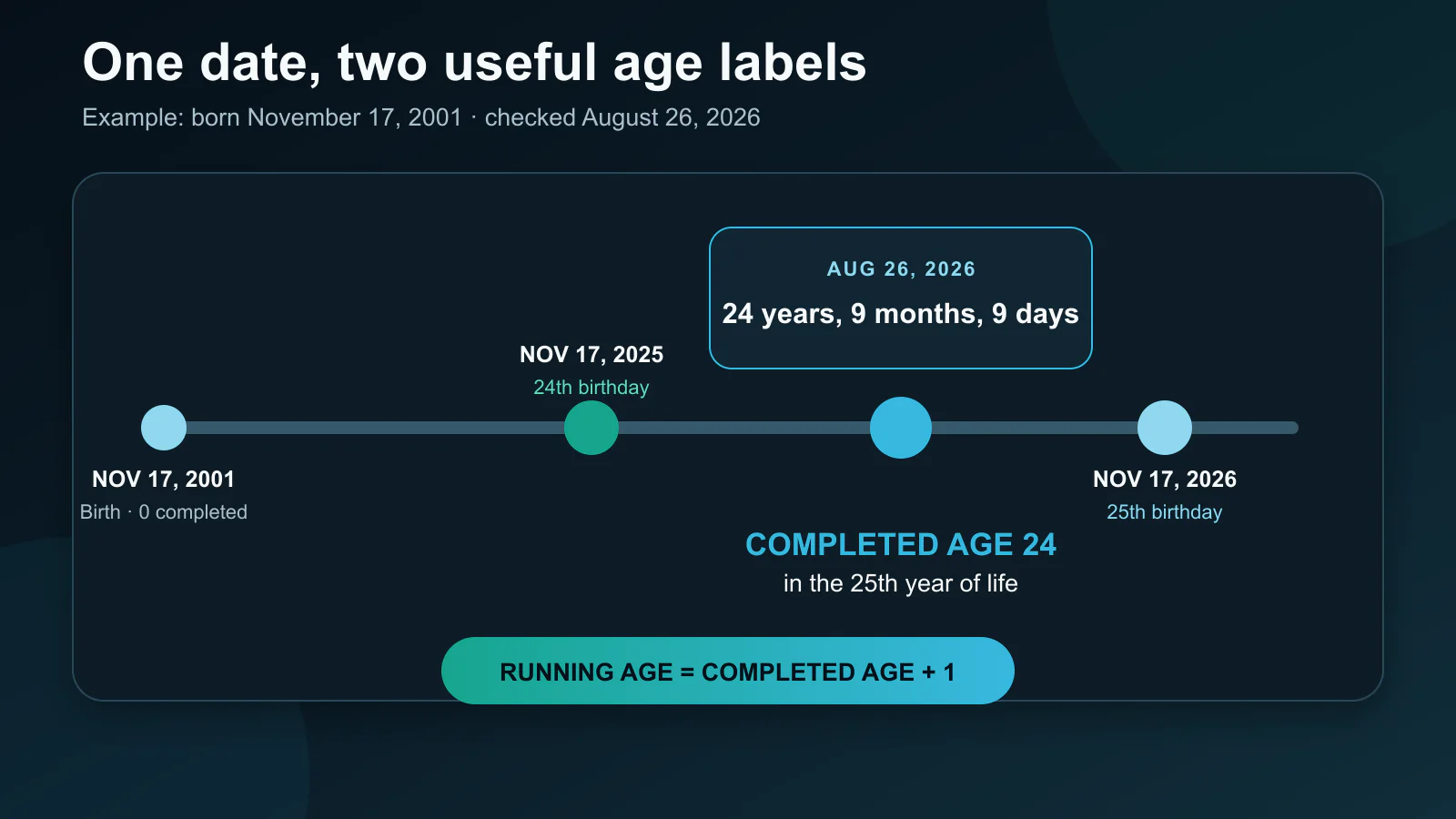
The person in the example completed 24 years on November 17, 2025. From that birthday until the next one, 24 remains the number of whole years they have completed. At the same time, the 25th year of their life is running.
On November 17, 2026, both labels move forward. Their completed age becomes 25, and their 26th year begins. With the usual meaning of “running age,” the two whole-number labels stay one apart:
Running age = completed age + 1
The word usual matters. “Running age” is an informal expression, not one universal administrative standard. Some speakers use it loosely or mean “current age including months and days.” When accuracy matters, say completed age, exact age, or in my 25th year instead of relying on the phrase alone.
What is completed age?
Completed age is the number of full years that have elapsed since birth at a particular date. It is also called age in completed years or age at last birthday.
This is not merely a calculator convention. The United Nations Statistics Division defines age at last birthday as the difference between the birth date and the event date expressed in completed solar years. The French Institute for Demographic Studies likewise describes age in completed years as age at the last birthday.
If you were born on November 17, 2001, your completed age on August 26, 2026, is 24—not 25—because your 25th birthday has not arrived. The extra nine months and nine days are part of your exact age, but they do not make another completed year.
Completed age answers this question: How many full birthdays after birth have passed by the date being checked?
What is running age?
Running age usually means the ordinal year of life a person is currently living. A newborn is in the first year of life, even though the baby has completed zero years. After the first birthday, the child has completed one year and is in the second year. After the 24th birthday, the person has completed 24 years and is in the 25th year.
That is why “25 running” generally means 24 completed, currently in the 25th year. The phrase is heard in parts of South Asia and in informal family conversation, but it can sound unfamiliar or ambiguous elsewhere. Clearer English is often:
- “I am 24 years old.”
- “I have completed 24 years.”
- “I am in my 25th year.”
- “My exact age is 24 years, 9 months, and 9 days.”
Running age is not the same thing as age grading in running, which compares athletic performance across age groups. Search results often mix those two intents because both contain the words running and age. If you mean a person’s current year of life, “year of life” is the useful interpretation.
Running age vs. completed age
| Situation | Completed age | Running age | Plain-English description |
|---|---|---|---|
| Birth day | 0 | 1 | Newborn; first year of life begins |
| The day before the first birthday | 0 | 1 | Nearly one year old |
| First birthday | 1 | 2 | One year old; second year begins |
| Six months after the 24th birthday | 24 | 25 | 24 years old; in the 25th year |
| 25th birthday | 25 | 26 | 25 years old; 26th year begins |
The table also shows why “I am 25 running” and “I am 25 years old” are not necessarily equivalent. The first can mean the 25th year is underway; the second conventionally means 25 full years have been completed.
Exact age adds the unfinished portion after the last birthday. A person can therefore have a completed age of 24, a running age of 25, and an exact age of 24 years, 9 months, and 9 days—all on the same date. Each expression answers a slightly different question.
How do you calculate completed age?
For a quick whole-year calculation, subtract the birth year from the target year. Then check whether the birthday has occurred by the target date.
- Start with target year − birth year.
- If the birthday has already occurred on the target date, keep the result.
- If the birthday is still ahead, subtract one.
Using November 17, 2001, and August 26, 2026:
- 2026 − 2001 = 25.
- November 17 has not occurred by August 26.
- Subtract one, so the completed age is 24.
The comparison must use the complete month-and-day pair, not the month alone. Someone born on August 27 has not reached their birthday on August 26; someone born on August 20 has.
For an exact result in years, months, and days, calendar borrowing becomes more delicate because months have different lengths. A date-aware age calculator is quicker and less error-prone than treating every month as 30 days.
How do you calculate running age?
Once completed age is known, add one to identify the year of life underway:
Running age = completed age + 1
In the same example, completed age 24 means the 25th year is running. It is clearer to write “in the 25th year of life” than “25 years old”, because “25 years old” normally describes completed age.
This formula is for the common year-of-life meaning. If a form, school, insurer, employer, or event organizer defines age differently, follow that definition. Some contexts use age on a cutoff date; others use an age band, a calendar-year cohort, age nearest birthday, or an exact date-and-time calculation. Those are separate rules, not alternative names for running age.
What does “age as on” mean?
“Age as on” means age calculated at a stated reference date. The reference date may be an application deadline, the first day of a school year, a competition date, or another cutoff—not necessarily today.
Suppose an application asks for age as on January 1, 2027. Entering today’s age can be wrong even if the form is completed in August 2026. You must compare the birth date with January 1, 2027. This is exactly why the ClockTools calculator includes a Calculate Age On field: the second date can be today, a past date, or a future cutoff date.
The wording around the cutoff matters too. “Must have completed 18 years,” “must be at least 18,” and “age at last birthday” point toward completed years, but the organization’s full rule controls. Do not infer eligibility from a casual running-age label.
Which age should you enter on a form?
Enter the value the form explicitly requests. When a form simply asks for age in years, completed age at the specified date is the widely used statistical meaning. The U.S. Census Bureau, for example, has long defined age at last birthday as the number of completed years, and the UK Office for National Statistics describes age as completed years at the last birthday.
Use this checklist before submitting anything important:
- Find the reference date: today, the submission date, or a stated cutoff.
- Look for words such as completed years, age at last birthday, exact age, or age next birthday.
- Enter years, months, and days only if the fields request that precision.
- Keep the date format straight;
03/04/2005can mean March 4 or April 3 depending on the form. - For legal, medical, immigration, insurance, school, or examination eligibility, follow the issuing organization’s instructions and ask it when the wording is unclear.
Running age can be perfectly useful in conversation. It is simply a poor guess for an undefined official field because it can make a person appear one year older than the number of full years lived.
Common mistakes
Subtracting years without checking the birthday
2026 − 2001 gives 25, but that is only the completed age if the 2026 birthday has occurred by the target date. Before the birthday, completed age is 24.
Calling running age “years old”
“25 running” may describe someone in the 25th year who is 24 years old in completed years. Saying “in my 25th year” prevents the listener from interpreting 25 as completed age.
Using today when the form gives a cutoff date
Age can change between today and the relevant date. Calculate against the date printed in the notice or form.
Treating months as equal blocks
Calendar months range from 28 to 31 days. Dividing a day count by 30 does not reliably produce a birthday-style age in years, months, and days.
Assuming every February 29 rule is identical
Calculators need a display convention for leap-day birthdays in non-leap years, while legal and institutional rules can vary by place and purpose. ClockTools uses February 28 for its practical next-birthday display in non-leap years. For an official decision, use the rule specified by the responsible organization.
Sharing more birth information than necessary
A full date of birth is personal information. When you only need to explain a calculation, a fictional example or the final age may be enough. ClockTools performs the age calculation in the browser and does not require an account.
A quick calculation with ClockTools
Open the ClockTools Age Calculator, enter the date of birth, and set Calculate Age On to the date that actually matters. The first number in the exact result is completed years. The remaining months and days show how far the person has moved through the next year of life.
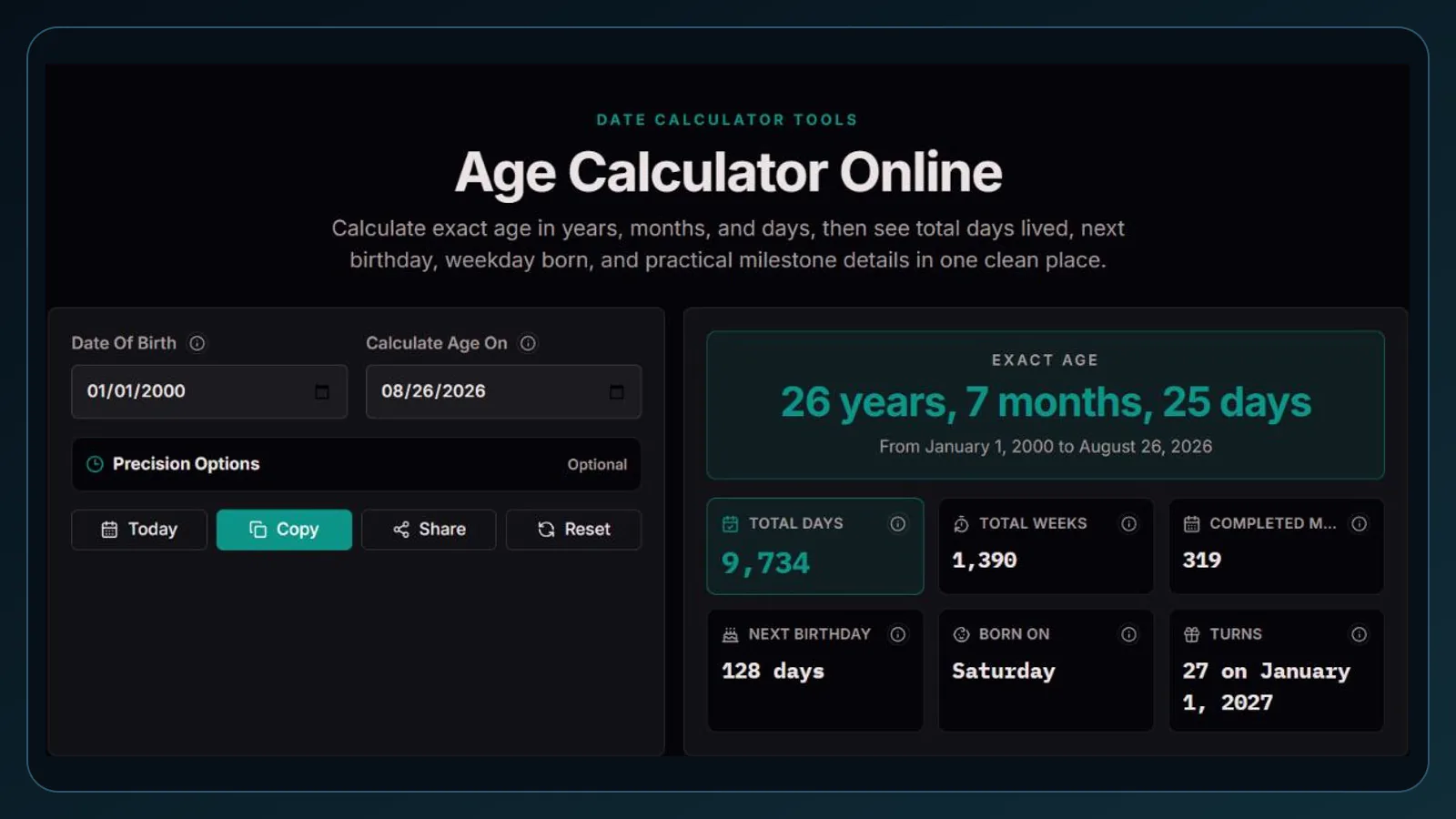
To state running age, add one to the completed-year number and phrase it as an ordinal year. If the calculator shows 24 years, 9 months, 9 days, say “24 years old” for completed age or “in the 25th year” for running age.
Related date questions need different tools. If you know an age and reference date but need to work backward, the date of birth calculator handles that inverse problem. When an event countdown is the real concern, the holiday countdown shows the time remaining instead of the person’s age.
The distinction is now small enough to remember: birthdays count completed years; the space after a birthday is the next year running. When a label matters, attach it to a specific date and use the wording the recipient expects.
Frequently Asked Questions
What is the difference between running age and completed age?
Completed age is the number of full years already lived at a stated date. Running age usually means the ordinal year of life currently underway, so it is one greater under that informal definition.
If I am 24 years old, what is my running age?
If 24 is your completed age, you are in your 25th year of life, commonly described as 25 running. Saying ‘in my 25th year’ is clearer than saying you are 25 years old.
Is running age always completed age plus one?
Yes when running age means the year of life currently underway. The phrase is informal and can be used differently, so confirm the intended definition whenever the result matters.
Should I enter running age or completed age on a form?
Follow the form’s wording and reference date. When it asks for age in years, age at last birthday, or completed years, use completed age at the specified date. Ask the issuing organization if its rule is unclear.
What does age at last birthday mean?
It means the number of full years completed on the most recent birthday before or on the date being checked. It is another way to describe age in completed years.
What does age as on a date mean?
It means age calculated at that particular reference date, which may be an application cutoff or event date rather than today.
What is the running age of a newborn?
A newborn has completed zero years and is in the first year of life. Under the usual year-of-life meaning, the running age is 1.
Does running age change on your birthday?
Yes. On a birthday, completed age increases by one and the next ordinal year of life begins. On the 25th birthday, completed age becomes 25 and the 26th year starts.
Is running age the same as exact age?
No. Exact age expresses elapsed time in years, months, and days. Running age is usually only the numbered year of life currently underway.

About The Author
Vigneshwaran Vijayakumar
Founder, Developer and Publisher of ClockTools | Digital Marketing Manager | India
Vigneshwaran is an engineer with decades of technical experience, including professional work as a Digital Marketing Manager in Dubai. His work connects data analysis, search engine optimization, conversion-rate optimization, content systems, visual production, and applied AI and machine learning. At ClockTools, he turns that multidisciplinary experience into focused browser utilities and practical, source-aware guides.