Randomizer Tools
What Are the Odds of 10 Heads in a Row?
Calculate a ten-head streak exactly, distinguish it from either uniform side, and interpret one real ten-flip batch without the gambler's fallacy.
By Vigneshwaran Vijayakumar, Developer and Publisher | | Reviewed under the ClockTools editorial policy
Table of contents
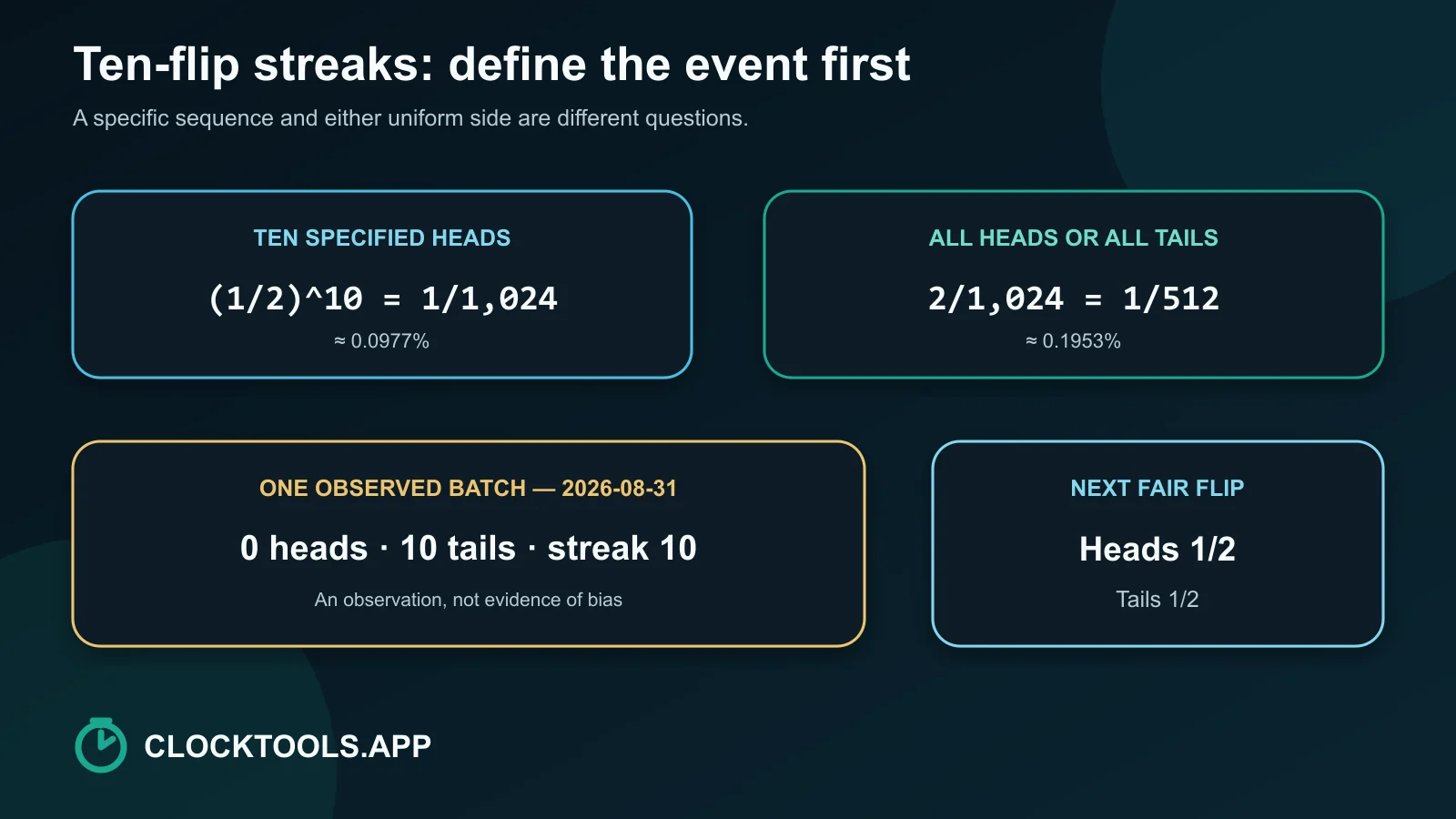
The probability of 10 heads in a row with a fair coin is (1/2)^10 = 1/1,024, about 0.0977%. If you mean ten identical results of either kind—ten heads or ten tails—the probability is 2/1,024 = 1/512, about 0.1953%. After either streak, the next independent fair flip is still 50% heads and 50% tails. Use the ClockTools coin flip probability calculator to run a ten-flip batch, then compare the observation with the calculation instead of treating one batch as proof.
How do you calculate 10 heads in a row?
For a fair coin, each required head contributes a factor of 1/2. Independent events multiply, so the exact ordered sequence is:
P(HHHHHHHHHH) = (1/2) × (1/2) × … × (1/2) = (1/2)^10 = 1/1,024.
That is approximately 0.0009765625 as a decimal or 0.09765625% as a percentage. OpenStax's explanation of independent events formalizes the multiplication rule: the outcome of one independent flip does not alter the probability of another.
The same calculation works for any one preselected sequence of ten outcomes. HTHTHTHTHT is exactly as likely as ten heads. Streaks feel special because their pattern is visually simple, not because that one sequence was less likely than every other specific sequence.
Why are “10 heads” and “10 matching sides” different?
“Ten heads” names one successful sequence. “Ten matching sides” names two mutually exclusive sequences: all heads or all tails.
| Event in one 10-flip batch | Exact probability | Approximate percentage |
|---|---|---|
| Ten heads | 1/1,024 | 0.0977% |
| Ten tails | 1/1,024 | 0.0977% |
| Either all heads or all tails | 1/512 | 0.1953% |
| Any other mix | 511/512 | 99.8047% |
This distinction prevents a common reporting error. Decide the event before observing the batch. If you announce “I am testing for ten heads,” ten tails is not the same event. If you announce “I am testing for a monochromatic ten-flip streak,” either result counts.
What happened in a real 10-flip test?
In one controlled ClockTools batch on 2026-08-31, the result was 0 heads and 10 tails, with a longest streak of 10. That is one genuine observation, not evidence that the generator favors tails. For a predeclared “all one side” event, it is one of the two qualifying sequences and has probability 1/512. For a predeclared “ten heads” event, it is a miss.
The page can run up to 1,000 independent flips, reports head/tail percentages and longest streak, and uses the browser's Web Crypto randomness. The implementation maps a random 32-bit value's low bit to the two outcomes. MDN documents that crypto.getRandomValues() fills a typed array with cryptographically strong random values. That makes the tool useful for demonstrations, but it is not a certification of a gambling system or a substitute for a formal audit.
Does a long streak change the next flip?
No, not for independent fair flips. After ten heads, the next flip remains:
P(heads next) = 1/2P(tails next) = 1/2
Thinking that tails is “due” is the gambler's fallacy. The history changes how unusual the completed sequence looks; it does not push a memoryless coin toward the opposite side. A physical coin can be biased, and a software generator can be flawed, but those are claims about the mechanism that require many observations and a suitable test—not intuition after a streak.
Is this the same as getting 10 heads somewhere in a longer run?
No. 1/1,024 answers a narrow question: are these ten specified consecutive flips all heads? A longer run creates multiple possible starting positions, and those candidate streaks overlap. For example, a 100-flip run offers many windows of ten, so the chance of at least one ten-head streak is larger than 1/1,024. You cannot get the exact answer by multiplying 91 windows by 1/1,024 because overlapping windows are not independent.
Also separate a streak from a count. “Exactly ten heads in twenty flips” ignores order and uses the binomial distribution. OpenStax's binomial distribution covers fixed independent trials with two outcomes and a constant success probability. “Ten consecutive heads somewhere” is a run problem and needs different counting or a simulation designed around windows.
How can you run a useful coin-flip experiment?
Write the rule before pressing the button:
- Define the event: a specific ten-head batch, either uniform side, or a streak anywhere in a longer run.
- Choose the number of batches in advance.
- Run the same batch size each time with Flip a Coin.
- Record each qualifying batch and the denominator; the Online Notepad is enough for a small classroom test.
- Compare the observed rate with the theoretical rate, including ordinary sampling variation.
For a control activity, compare the same protocol with Roll a Dice. A preselected run of ten sixes has probability (1/6)^10, illustrating how the number of equally likely outcomes changes the calculation.
Which probability mistakes should you avoid?
| Mistake | Correction |
|---|---|
| Counting ten tails after asking only for ten heads | Define whether one sequence or either uniform sequence qualifies. |
| Saying the next flip is more likely to be tails | Independence keeps the next fair flip at 1/2. |
| Treating one rare batch as proof of bias | Test the mechanism over many preplanned trials. |
| Using 1/1,024 for a streak anywhere in a long run | Account for multiple, overlapping start positions. |
| Confusing exactly ten heads with ten consecutive heads | Counts use a binomial model; runs preserve order. |
The practical lesson is not that streaks are impossible. It is that rare events appear naturally when enough trials are observed, and their interpretation depends on the question written before the observation.
Frequently Asked Questions
What percentage chance is 10 heads in a row?
For a fair coin, it is 1/1,024, which equals 0.09765625% and rounds to about 0.0977%.
What are the odds of 10 tails in a row?
They are the same as ten heads: 1/1,024, or about 0.0977%, for a fair independent coin.
What is the chance of either 10 heads or 10 tails?
The two qualifying sequences are mutually exclusive, so add them: 2/1,024 = 1/512, about 0.1953%.
After 10 heads, is tails more likely next?
No. If the coin is fair and flips are independent, the next result remains 50% heads and 50% tails. The completed streak does not make tails due.
Is every 10-flip sequence equally likely?
Yes, under a fair independent model. Every specific ordered sequence has probability 1/1,024, including ten heads and alternating heads and tails.
Does one 10-result streak prove a coin or generator is biased?
No. A rare result can occur under a fair process. Bias requires a preplanned sample, an appropriate statistical test, and evidence about the mechanism.

About The Author
Vigneshwaran Vijayakumar
Founder, Developer and Publisher of ClockTools | Digital Marketing Manager | India
Vigneshwaran is an engineer with decades of technical experience, including professional work as a Digital Marketing Manager in Dubai. His work connects data analysis, search engine optimization, conversion-rate optimization, content systems, visual production, and applied AI and machine learning. At ClockTools, he turns that multidisciplinary experience into focused browser utilities and practical, source-aware guides.