Clock Tools
How Do Time Zones Work? UTC, Offsets and DST
A time zone is a dated rule set for local civil time, not merely a fixed number of hours from UTC.
By Vigneshwaran Vijayakumar, Developer and Publisher | | Reviewed under the ClockTools editorial policy
Table of contents
A time zone is not just a number added to UTC. It is a named set of civil-time rules for a place, including the offset that applies on a particular date and any daylight-saving transitions. To compare cities reliably, keep the instant fixed, select each place by its IANA zone, and let current time-zone data calculate the local reading.
That is the job of the ClockTools World Clock: choose cities, make one the featured location, and compare the same moment across all of them. The explanation below gives you the mental model behind the tool, so an offset change or a half-hour zone does not look like a mistake.
The three-layer model
Most time-zone confusion disappears when you separate three things that are often collapsed into one label.
- An instant is one point on the global timeline. A timestamp such as
2026-07-15T12:00:00Zidentifies that point withZfor UTC. - An offset is the difference between UTC and a local clock at that instant, such as
+05:30or-04:00. - A time zone is the rule set that determines which offset a named place uses on a given date. Examples include
Asia/KolkataandAmerica/New_York.
The IANA time-zone database records histories of offsets and daylight-saving behavior for representative locations. Its names usually combine a region and a city. A city name is not decoration: it is the key that lets software select the appropriate rules instead of guessing from a short abbreviation.
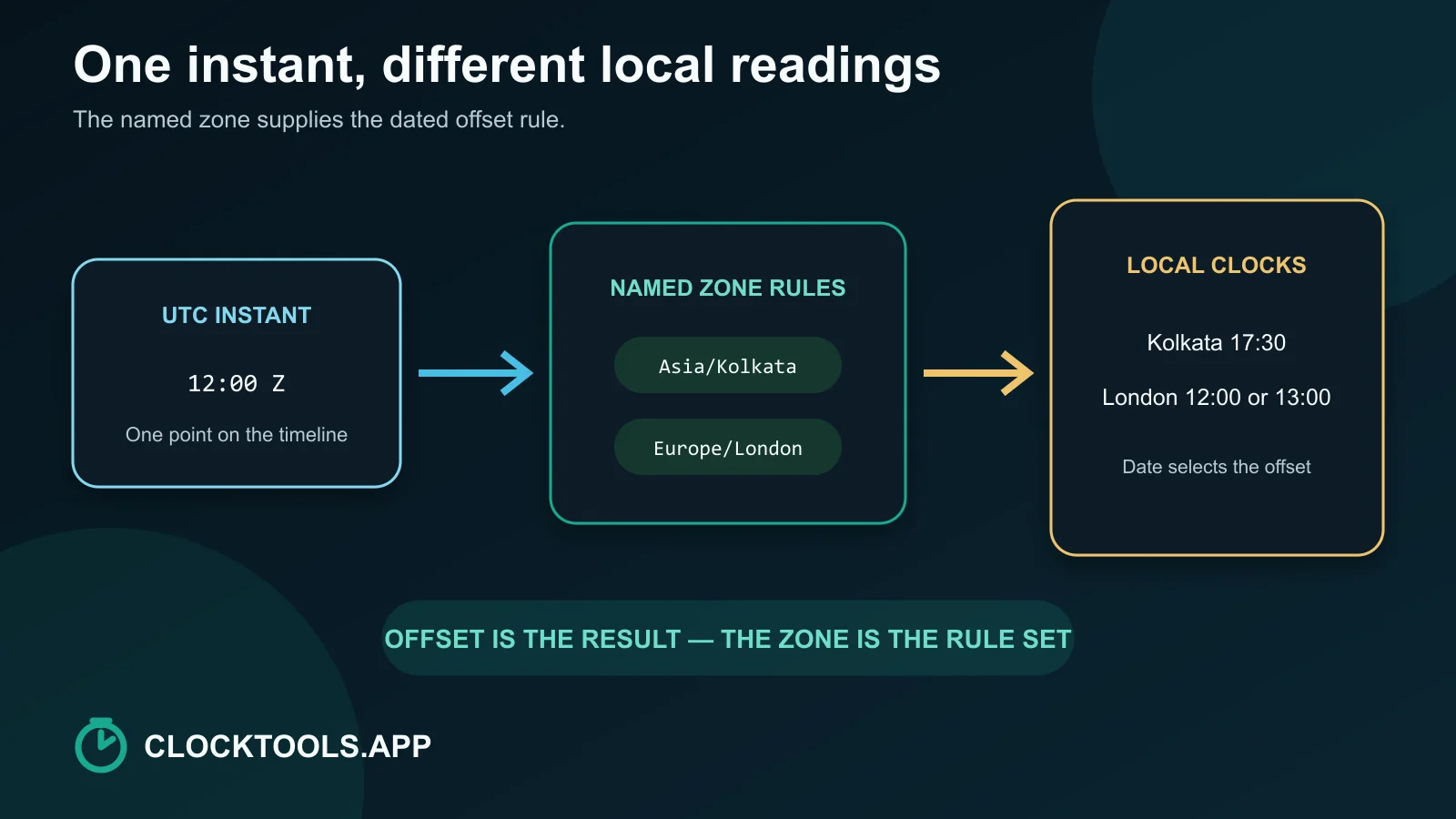
This model explains why UTC+1 and Europe/London are not interchangeable. The fixed offset stays one hour ahead of UTC. London's named zone can use different offsets across the year because its civil-time rules include seasonal changes.
One instant, three local readings
Take the same UTC instant and format it for three named zones. The date matters because New York and London change offsets seasonally while Kolkata does not currently use daylight saving time.
| UTC instant | Asia/Kolkata | Europe/London | America/New_York |
|---|---|---|---|
| 15 January 2026, 12:00 UTC | 17:30, UTC+05:30 | 12:00, UTC+00:00 | 07:00, UTC-05:00 |
| 15 July 2026, 12:00 UTC | 17:30, UTC+05:30 | 13:00, UTC+01:00 | 08:00, UTC-04:00 |
The UTC instant remains unchanged across each row. Only the presentation changes. That distinction is essential in calendars, logs, flight times, release windows, and scheduled jobs. Store or transmit an unambiguous instant, then format it in the reader's zone at the edge of the system.
The two rows also show why a memorized statement such as “New York is ten and a half hours behind India” is only conditionally true. The gap shown here is ten and a half hours in January and nine and a half hours in July. The place did not move; one zone changed its offset.
Offsets are results, not rules
An offset answers a narrow question: how far is this local reading from UTC right now or at the supplied date? It does not tell you what the offset was last year or what a government may set next year.
The IANA database notes that governments control civil-time and daylight-saving rules and sometimes change them with little notice. Software updates carry revised data to browsers and operating systems. This is why a durable calendar entry should retain a named zone when the local wall time matters. Recording only +02:00 loses the rule identity needed for a future summer or winter calculation.
Short abbreviations are another weak identifier. IST can mean India Standard Time, Irish Standard Time, or Israel Standard Time in different contexts. Use a city or an IANA identifier for calculations; reserve abbreviations for a display where the place is already obvious.
Daylight saving creates the surprising cases
Daylight saving time is a civil rule that moves local clocks for part of the year. The NIST daylight-saving overview explains the current United States transition framework and its exceptions. Other jurisdictions use different dates, have stopped seasonal changes, or never adopted them.
A spring transition can skip local clock readings. A fall transition can repeat them. For example, a local time near a fall-back boundary may occur twice with two different offsets. A timestamp that contains only 2026-11-01 01:30 and a city name may therefore need a disambiguation policy.
The safe order is:
- start from an exact instant when one already exists;
- keep the named zone with a future local appointment;
- ask the time-zone library to resolve the offset for that date;
- show the offset in confirmations when a repeated or skipped hour is possible.
Daylight saving is not the only reason zones differ. Some current zones use 30-minute or 45-minute offsets. Political boundaries also make the world map irregular, so the familiar 24 equal vertical bands are a teaching approximation, not a scheduling database.
Inside the ClockTools World Clock
The live ClockTools tool opens with New York, London, Dubai, Singapore, Tokyo, and Sydney. In our source and live-page check, each card is formatted through the browser's Intl.DateTimeFormat support using a named time zone. That means the displayed offset is calculated for the compared instant rather than stored as a permanent city constant.
Two reproduced observations are especially useful:
- Moving the comparison control from Now to a positive or negative hour shifts one underlying instant for every selected city. The city-to-city relationship stays coherent because the cards do not advance independently.
- Searching for a city adds a named-zone result and makes it the featured card. The selected set is stored in the browser, and a share action can include non-default cities plus the featured city and comparison offset in the URL.
Use the online clock when you need one large local display. Use the world clock when the reader job is comparison. If the outcome is a future observance rather than a city conversion, the holiday countdown keeps the target date visible without turning a zone comparison into a manual timer.
A practical conversion protocol
Use this short protocol when a meeting, release, or event crosses zones.
- Write the source time with its date and named zone, not only a three-letter abbreviation.
- Convert it to an instant using current time-zone data.
- Format that instant for each destination zone.
- Check whether any zone changes its offset before the event date.
- Put the source zone and at least one UTC offset in the invitation or handoff note.
- Recheck long-range events after operating-system or calendar updates if a government has announced a rule change.
For a recurring meeting, test at least one date on each side of a daylight-saving transition. A single January example does not prove that the same city gap will hold in July. The two-date matrix above is a compact artifact you can reuse: choose a winter date, choose a summer date, and compare the same UTC hour.
Where does simple arithmetic break?
Adding a remembered offset works for a one-off conversion only when the offset is known for that exact date. It breaks in predictable places.
| Shortcut | Failure mode | Better input |
|---|---|---|
| “London is UTC+1” | Wrong during standard time | Europe/London plus the date |
| “India is 5 hours ahead” | Drops the extra 30 minutes | Asia/Kolkata or +05:30 for that instant |
| “EST means New York time” | Ignores daylight time and abbreviation ambiguity | America/New_York |
| “The clock always jumps at 02:00” | Transition rules differ by jurisdiction | Current zone database |
| “Longitude determines the legal time” | Civil boundaries and national policy override neat bands | Named civil zone |
The point is not to avoid arithmetic. It is to do arithmetic after the correct rules have produced the offset. A world clock turns that rule lookup into a visible comparison, while UTC preserves the instant underneath every card.
Frequently Asked Questions
How many time zones are there?
The 24-hour rotation explains the familiar idea of 24 one-hour bands, but real civil time is not divided into only 24 usable rules. Named zones include half-hour and quarter-hour offsets, regional histories, and daylight-saving transitions.
What is the difference between UTC and a time zone?
UTC is the reference time scale used to identify an instant. A named time zone applies civil rules to that instant and produces a local date, time, and offset for a place.
Why does the time difference between two cities change?
One city may enter or leave daylight saving time while the other does not, or they may change clocks on different dates. The underlying UTC instant stays fixed while a local offset changes.
Is a UTC offset the same as a time zone?
No. An offset such as +05:30 is one numeric difference from UTC. A named zone such as Asia/Kolkata carries the dated rules that determine which offset applies.
Why should I avoid three-letter time-zone abbreviations?
Abbreviations can be ambiguous and may hide daylight-saving behavior. A named IANA zone plus a date gives software enough information to select the intended rules.
How should I schedule a future event across time zones?
Store the intended local wall time with its named zone, resolve it with current time-zone data, and include an unambiguous instant or UTC offset in the invitation. Recheck long-range events after announced rule changes.

About The Author
Vigneshwaran Vijayakumar
Founder, Developer and Publisher of ClockTools | Digital Marketing Manager | India
Vigneshwaran is an engineer with decades of technical experience, including professional work as a Digital Marketing Manager in Dubai. His work connects data analysis, search engine optimization, conversion-rate optimization, content systems, visual production, and applied AI and machine learning. At ClockTools, he turns that multidisciplinary experience into focused browser utilities and practical, source-aware guides.