Date Calculator Tools
How Do Leap Years Affect Age Calculations?
A calendar-first explanation of leap days, completed age, February 29 birthdays, and honest date-of-birth calculations.
By Vigneshwaran Vijayakumar, Developer and Publisher | | Reviewed under the ClockTools editorial policy
Table of contents
A leap year changes the number of days you have lived, but it does not make calendar age a simple division problem. Completed age in years normally advances on a birthday, while total days lived counts every midnight crossed—including February 29. For people born on February 29, the date used in a common year can depend on the reminder system, institution, or law involved.
Use the ClockTools Date Of Birth Calculator when you know an age and need to work backward to a possible birth date. Use the Age Calculator when you already know the birth date and want completed years, months, days, or total elapsed time.
What actually changes in a leap year?
The Gregorian calendar inserts February 29 in most years divisible by four, except century years that are not divisible by 400. The NIST explanation of leap years describes why the extra day keeps the calendar aligned with the roughly 365.242-day tropical year. The U.S. Naval Observatory calendar guide states the divisible-by-4, century, and divisible-by-400 rule explicitly.
That extra date affects elapsed-day totals. Someone alive through February 29 has lived one more calendar day than they would in a 365-day year. It does not mean everyone reaches their next completed age early. A person born on July 10 still turns the next whole-number age on July 10; February 29 simply appears somewhere in the interval.
Three quantities are easy to mix up:
| Quantity | What it measures | Leap-day effect |
|---|---|---|
| Completed age | Full calendar years since birth | Changes on the applicable anniversary |
| Exact calendar difference | Years, remaining months, and remaining days | Includes real month lengths and leap days |
| Total days lived | Whole calendar days between two dates | Gains an extra day whenever February 29 lies inside the interval |
How does a February 29 timeline work?
Consider a person born on February 29, 2000. On February 28, 2024, their 2024 leap-day birthday has not arrived. On February 29, the calendar contains the matching month and day. On March 1, that date has passed. The same sequence cannot be copied into 2025 because February ends on the 28th.
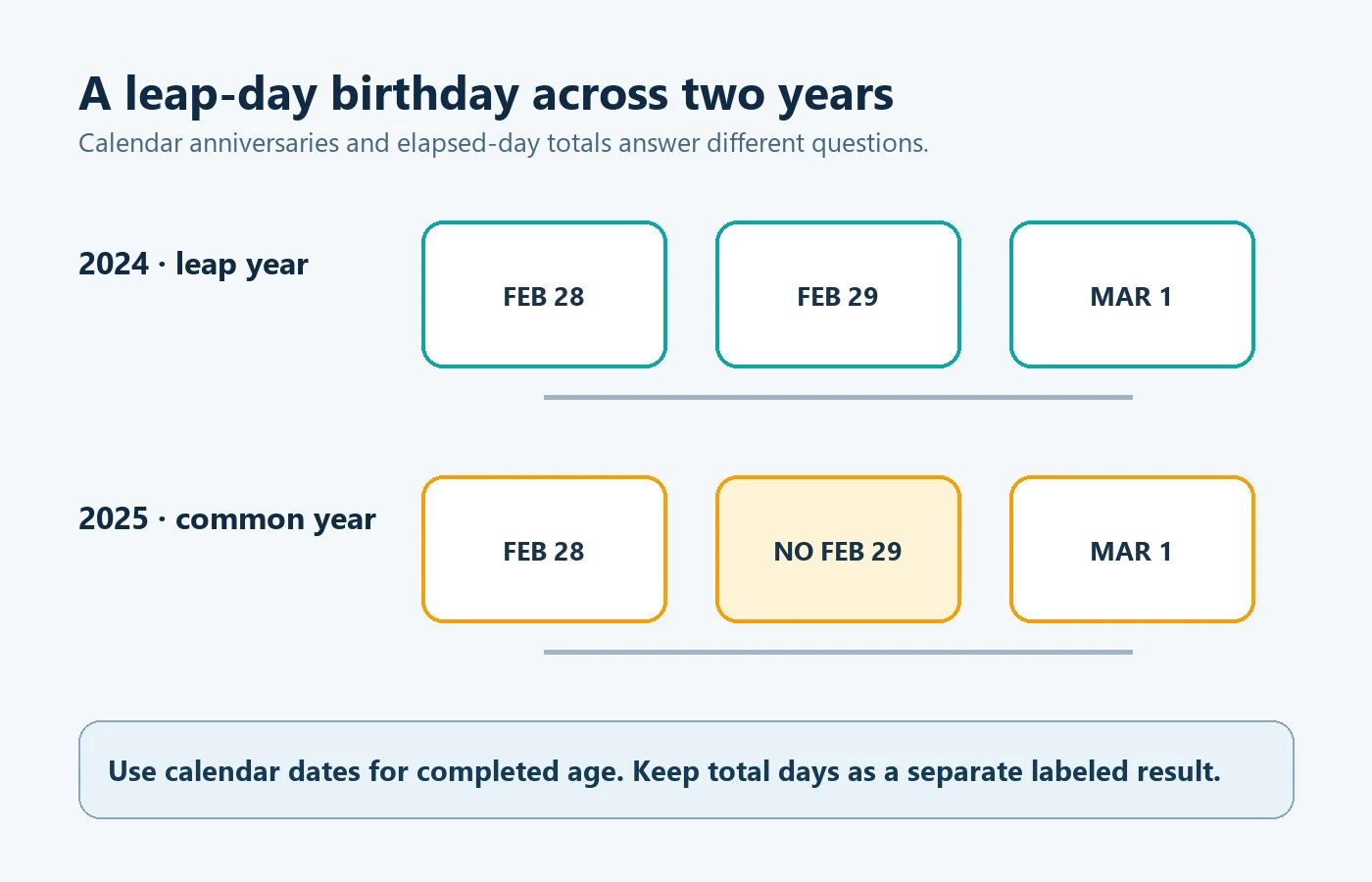
A reminder application must choose a display convention for common years, often February 28 or March 1. That choice is useful for reminders but is not automatically a legal rule. The important editorial boundary is to describe what the software displays and not turn it into a universal claim about eligibility, contracts, school entry, insurance, or statutory age.
The phrase “only five birthdays” is also misleading for a 20-year-old leap-day baby. They have had 20 yearly birthday anniversaries in ordinary language, even though only five calendar years in that span contained February 29.
Which age calculation method answers your question?
Choose the method from the information you actually have:
- If you know a birth date, compare it with a calculate-on date using calendar years, months, and days.
- If you know an exact age such as 25 years, 3 months, and 8 days, work backward with calendar-aware subtraction.
- If you know only “25 years old,” return a possible birth-date range rather than inventing one exact day.
- If you know a verified total-days-lived value, subtract that many calendar days and label the result as a day-count calculation.
This distinction matters near birthdays. Two people who are both described as 25 today can have birth dates almost a full year apart. Years-only age is a category, not a unique timestamp.
How does ClockTools handle calendar arithmetic?
The current ClockTools Date Of Birth Calculator exposes three separate modes instead of forcing incomplete inputs into one formula. Exact Age accepts years, months, and days. Years Only returns the earliest and latest possible birth dates for that completed age. Total Days Lived subtracts a full calendar-day count from the chosen reference date.
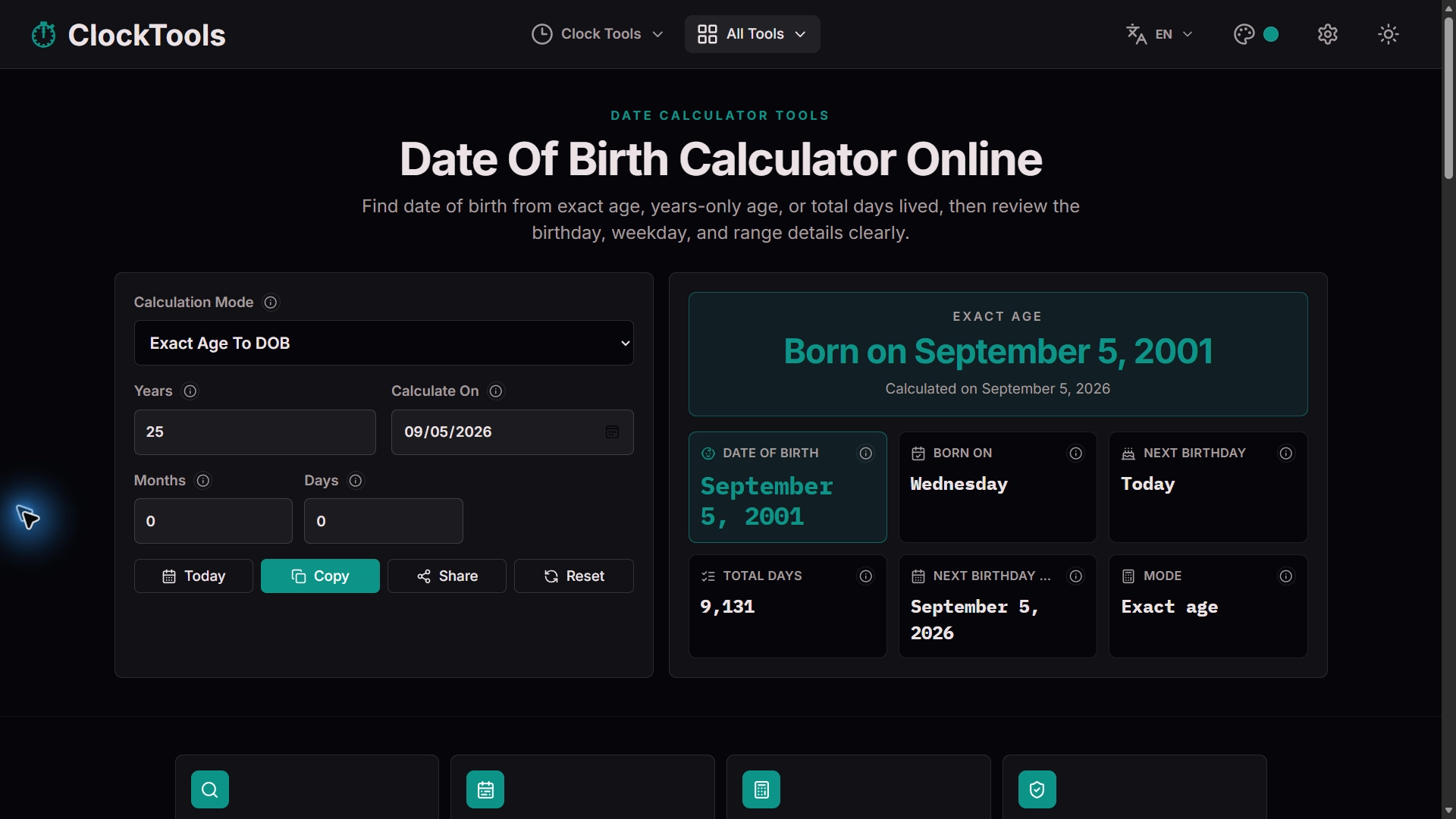
The tool also shows supporting details such as weekday, next birthday, total days, or range length where applicable. Its calendar arithmetic subtracts real years and months, then clamps an invalid day to the last valid day of the resulting month. That is important when an input crosses February or a 30-day month.
For a reproducible check, set a fixed calculate-on date rather than relying on “today,” record which mode you used, and copy the result with its method note. Changing only the reference date lets you see whether the boundary is the birthday, the end of a month, or a leap day.
Why does dividing by 365 give the wrong answer?
Dividing total days by 365 assumes every year has the same length. It will drift after leap days, and the decimal remainder does not map cleanly to calendar months because months range from 28 to 31 days.
Dividing by 365.25 is an average, not a birthday rule. It can be useful in rough duration estimates, but it cannot tell whether a birthday has occurred on a particular date. A calendar comparison asks the correct question: has the anniversary for this year passed? A total-day calculation asks a different correct question: how many date boundaries lie between these two dates?
Keep the unit attached to the result. “9,132 days lived” and “25 completed years” may both be correct, but they are not interchangeable answers.
Which date belongs in an official record?
Use the original birth document for the date of birth. Use the rule stated by the organization for an age cutoff or February 29 anniversary. Do not substitute a calculator convention when a school, court, insurer, employer, competition, or government form defines its own rule.
ClockTools can reproduce the calendar arithmetic and expose incomplete information honestly. It cannot decide which jurisdiction or policy governs a real-world deadline. If the result changes access to a service or legal status, preserve the source dates and ask the responsible organization how it treats leap-day birthdays.
Frequently Asked Questions
Does a leap year make everyone one day older?
Everyone who lives through February 29 accumulates one additional calendar day, but completed age in years still changes on the applicable birthday rather than every 365 days.
How old is a person born on February 29?
Their completed age is the number of birthday anniversaries defined by the calendar or governing rule, not the number of February 29 dates that have occurred. For an official decision, verify the applicable local rule.
Should I calculate age by dividing days lived by 365?
No. That shortcut drifts because calendar years have different lengths. Compare calendar dates for completed years, months, and days, or keep the answer explicitly as total days lived.
What happens to a February 29 birthday in a common year?
Calendars have no February 29 in a common year. Applications may display February 28 or March 1 for reminders, while legal and administrative rules vary by jurisdiction and purpose.
Can years-only age identify an exact date of birth?
No. A completed age such as 25 describes a possible one-year birth-date window unless the month and day, exact age, or total day count is also known.

About The Author
Vigneshwaran Vijayakumar
Founder, Developer and Publisher of ClockTools | Digital Marketing Manager | India
Vigneshwaran is an engineer with decades of technical experience, including professional work as a Digital Marketing Manager in Dubai. His work connects data analysis, search engine optimization, conversion-rate optimization, content systems, visual production, and applied AI and machine learning. At ClockTools, he turns that multidisciplinary experience into focused browser utilities and practical, source-aware guides.