Stopwatch Tools
How Does Increment Work on a Chess Clock?
A turn-by-turn explanation of Fischer increment, including 3+2 clock arithmetic, delay comparisons, and practical clock procedure.
By Vigneshwaran Vijayakumar, Developer and Publisher | | Reviewed under the ClockTools editorial policy
Table of contents
Chess-clock increment is a fixed time bonus tied to each completed move. On the ClockTools chess clock, a 3 + 2 game gives each player three starting minutes and adds two seconds to the player who has just moved when that player presses the active clock. If a move takes less than two seconds, the clock can finish the turn with more time than it had at the start; if it takes longer, only the difference is lost.
What happens during one increment turn?
Think of a turn as three events: the player’s clock runs, the player moves a piece, and the player presses the clock. On ClockTools, that press settles the elapsed thinking time, records the move, adds the configured increment to the mover’s remaining time, and starts the opponent’s clock.
Suppose White begins a turn with 03:00, thinks for four seconds, and then presses in a 3 + 2 game. The arithmetic is 180 - 4 + 2 = 178 seconds, displayed as about 02:58. A real browser display may show a nearby rounded value depending on exactly when the press lands. The essential rule is unchanged: elapsed time comes off, then the fixed bonus is credited.
This is cumulative timing because unused bonus can remain on the clock. It is not a pause button and it does not give both players two seconds at once.
What does 3+2 look like move by move?
The diagram follows one side through three deliberately different turns.
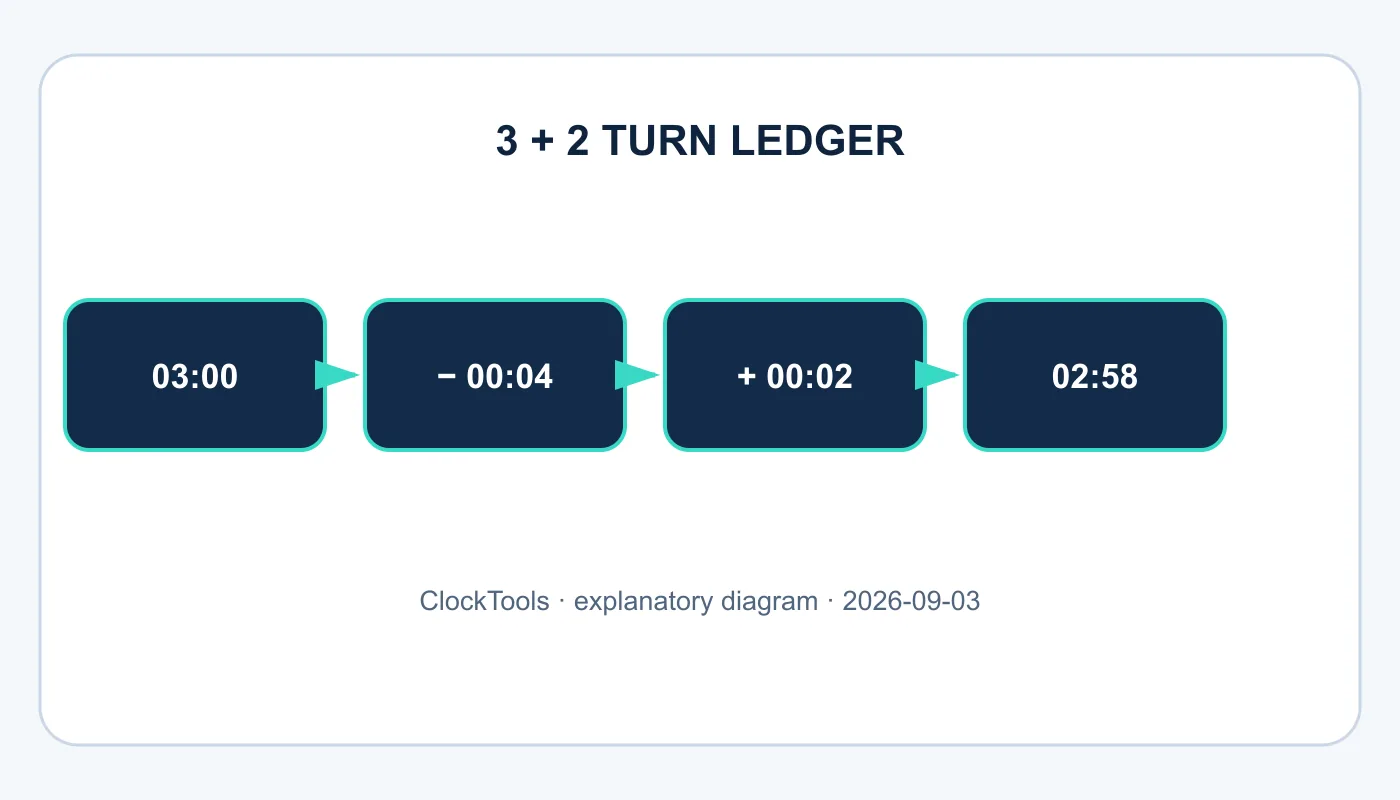
| Turn | Time at start | Thinking time | Increment | Time after press |
|---|---|---|---|---|
| Quick opening move | 03:00 | 1 second | +2 seconds | 03:01 |
| Normal move | 03:01 | 5 seconds | +2 seconds | 02:58 |
| Long calculation | 02:58 | 22 seconds | +2 seconds | 02:38 |
This ledger is a hypothetical calculation, not a record of a rated game. It demonstrates why the notation needs both numbers. A player cannot predict the remaining clock from move count alone; thinking time still controls the result.
I also reproduced the live 3 + 2 preset. Both clocks began at 03:00. After White used roughly four seconds and pressed, the page recorded one White move, stopped White near 02:57, and started Black at 03:00. The observed direction matched the ledger: White lost the thinking time but recovered two seconds.
Can increment create more remaining time?
Yes. In the quick-move row above, one second is spent and two seconds are added, so the player gains one net second. Repeat that pattern and the reserve grows. That does not make the game unlimited: difficult moves can consume the accumulated buffer quickly, and the opponent’s clock follows its own independent history.
The fastest way to audit a surprising display is to use this equation:
ending time = starting time - elapsed turn time + increment
Use precise values before rounding. A clock that shows tenths below a low-time threshold can make the bookkeeping easier to see, while a seconds-only display may appear to jump because presentation rounding and the press do not occur on exact whole seconds.
How is increment different from delay?
Increment and delay both soften time pressure, but they do different arithmetic.
| Timing mode | What happens each turn | Can unused allowance accumulate? |
|---|---|---|
| Fischer increment | A fixed bonus is associated with each completed move | Yes |
| Delay | Main time does not decrease until the delay is used | No |
| Sudden death | Every elapsed second comes from the main reserve | No allowance exists |
With a five-second delay, a three-second move leaves the main reserve unchanged, but the unused two seconds vanish when the turn ends. With a five-second increment, that same three-second move produces a net gain of two seconds. The FIDE Laws of Chess distinguish cumulative timing from delay and require the time control to be specified in advance.
Do not use the labels interchangeably when setting a match. A 5 d 3 delay game and a 5 + 3 increment game can diverge substantially after dozens of moves.
When is a chess move complete?
For ordinary over-the-board procedure, first make the move on the board and then press your own clock. FIDE Article 6.2 says that pressing pauses the mover’s clock and starts the opponent’s clock; that action completes the move. The time between moving the piece and pressing still belongs to the mover. The FIDE Rules Commission clock guide provides a focused companion explanation of Article 6.
That detail explains why increment is linked to a completed move rather than to merely touching a piece. It also prevents a player from pressing early to collect time before playing. In formal competition, use the organizer’s equipment and ask the arbiter about irregularities. The browser tool is useful for casual games and practice, but it does not adjudicate illegal moves or every flag-fall exception.
Which setup mistakes change the game?
The largest mistakes happen before the first move.
| Mistake | Visible symptom | Correction |
|---|---|---|
3 + 2 entered as 3 + 0 | No time returns after a press | Select Fischer increment and set two bonus seconds |
| Delay selected instead of increment | Fast moves preserve time but never build a reserve | Confirm the timing-mode label before starting |
| Wrong player started | The side to move is waiting while the other clock runs | Reset and choose the correct first mover |
| Pressing the opponent’s panel | Turn transfer does not match board procedure | Press the active player’s own clock after moving |
| Changing settings mid-game | Earlier and later moves use different rules | Agree and apply the control before play |
For a shared countdown rather than alternating reserves, use an online timer. For open-ended elapsed time and laps, use the stopwatch. Those tools answer different timing questions and should not be substituted for a two-player clock.
How should you test a chess clock before play?
Run a two-move rehearsal. Set a short base time with the intended bonus, start the correct side, wait longer than the increment, and press. Confirm that the mover’s net loss equals elapsed time minus the bonus and that only the opponent becomes active. Reset, make a move faster than the bonus, and confirm that the mover can gain time.
Then check sound, vibration, table orientation, fullscreen behavior, and the device’s sleep settings. Pause once and verify that neither reserve changes. This small test catches a wrong timing mode without risking the real game.
Record the control in standard plain language—“three minutes plus two seconds increment per move”—instead of relying on a screenshot. If the game matters, both players should be able to explain the setting before White’s first clock starts.
Frequently Asked Questions
What does 3+2 mean on a chess clock?
Each player starts with three minutes and receives two seconds of increment for each completed move. The two seconds belong to the player who just moved, not the opponent whose clock is starting.
Can a player gain time with increment?
Yes. If a player completes a move faster than the increment, their remaining time after the bonus can be higher than it was at the start of that turn.
Is increment added before or after a move?
Clock implementations may describe the bookkeeping differently, but the practical cumulative result is a fixed bonus associated with every move. On ClockTools, the bonus is applied when the player presses the active clock to complete the move.
What is the difference between increment and delay?
Increment adds time that can accumulate. Delay protects an initial part of each turn before the main reserve decreases, but unused delay does not accumulate.
Should I press the chess clock before moving?
No. In normal over-the-board procedure, make the move and then press your own clock. FIDE treats pressing the clock as completing the move.
Does flag fall always mean a loss?
Not in every official position. The applicable rules and the possibility of checkmate can affect the result, so a browser clock should not replace an arbiter in formal play.

About The Author
Vigneshwaran Vijayakumar
Founder, Developer and Publisher of ClockTools | Digital Marketing Manager | India
Vigneshwaran is an engineer with decades of technical experience, including professional work as a Digital Marketing Manager in Dubai. His work connects data analysis, search engine optimization, conversion-rate optimization, content systems, visual production, and applied AI and machine learning. At ClockTools, he turns that multidisciplinary experience into focused browser utilities and practical, source-aware guides.